News
2026-04-14
A mobile tool storage cabinet is a freestanding unit mounted on casters, allowing technicians and tradespeople to roll their entire tool inventory directly to the work area. Unlike wall-mounted tool boards or stationary chests, a mobile cabinet eliminates repeated trips across the shop floor — a small efficiency gain that compounds into hours saved over a busy workweek.
The defining hardware is the caster set. Heavy-duty swivel casters rated at 150–200 lbs each are standard on professional-grade units, with at least two locking wheels to prevent rolling during use. On smooth epoxy floors the difference between 3-inch and 5-inch casters is negligible; on uneven concrete or rubber mat surfaces, larger-diameter wheels roll noticeably more smoothly and reduce the risk of drawers rattling open.
Beyond casters, true mobility requires a low center of gravity. Manufacturers achieve this by placing heavier drawers — wider and deeper ones intended for power tools and air tools — at the bottom of the cabinet, while shallower drawers for sockets, bits, and measuring tools sit higher. This layout also mirrors natural ergonomic reach zones, keeping frequently used items at waist height.

Not every mobile tool cabinet is built for the same job. Understanding the main categories helps narrow the choice before comparing individual specs.
When evaluating any mobile tool storage cabinet, the following specifications directly affect long-term satisfaction:
| Specification | Entry-Level Range | Professional Range |
|---|---|---|
| Steel gauge (body) | 20–22 gauge | 16–18 gauge |
| Drawer weight capacity | 30–60 lbs each | 100–200 lbs each |
| Drawer slide type | Epoxy-coated steel slides | Ball-bearing full-extension |
| Caster diameter | 3 inches | 5–8 inches |
| Locking mechanism | Single keyed lock (top) | Central locking bar, all drawers |
| Work surface | Powder-coated steel top | Stainless steel or hardwood butcher block |
Ball-bearing full-extension slides are worth prioritizing even on a budget purchase. They allow the drawer to open 100% of its depth, exposing tools at the very back, and they sustain smooth operation far longer than basic slides under daily heavy loads.
Cabinet body thickness is expressed in gauge — a counterintuitive scale where a lower gauge number means thicker steel. A 16-gauge body panel measures approximately 1.5 mm thick; a 22-gauge panel is closer to 0.75 mm. In a shop environment where a loaded tool cart can be struck by forklifts, rolling carts, or falling equipment, body rigidity directly affects how long the drawers continue to align and slide properly.
Welded construction outperforms bolted or riveted assemblies in long-term rigidity. Look for full-seam welding at the corners and drawer slide mounting points rather than spot-welded joints, which can flex under heavy lateral loads.
The interior drawer surface finish affects both tool protection and cleaning ease. Powder-coated interiors resist rust and prevent loose metal chips from scratching precision measuring tools. Some professional cabinets include removable foam drawer liners or peg-hole grids for custom organization, which also prevent tools from shifting during transit.
A common mistake is choosing a cabinet based on current tool count rather than projected inventory. Tool collections grow; storage rarely shrinks. A practical rule of thumb: fill a new cabinet no more than 70–75% at purchase, leaving headroom for acquisitions over the next two to three years.
Width also determines aisle compatibility. In a two-car garage workshop, a 41-inch cabinet fits comfortably along one wall with room to open drawers fully. In a commercial bay with vehicle lifts, cabinet width must account for vehicle overhang — a 56-inch unit can block access to lift controls if positioned carelessly.
Height is a subtler consideration. A standard roll-around cabinet without a top chest sits around 37–41 inches — close to average workbench height. Adding a matching top chest brings the total to 60–68 inches, which exceeds comfortable reach for technicians under 5'8". Some manufacturers offer intermediate-height "mid boxes" that add storage without pushing the top chest out of comfortable reach.
Tool theft is a genuine operational risk in shared shops and on open job sites. Most mobile tool cabinets ship with a keyed lock, but the implementation varies significantly. A single top-drawer lock that engages a vertical locking bar running through all drawers is more secure than individual drawer latches, which can be defeated one by one.
For high-value environments, some professional cabinets support aftermarket electronic locks or incorporate built-in USB charging ports and LED interior lighting powered by the shop's electrical system — features that indicate the unit was designed for a semi-permanent bay setup rather than frequent relocation.
Regardless of lock quality, anchoring a loaded full-size cabinet to the floor via anchor bolts is advisable in any facility accessible to multiple personnel. An unanchored cabinet tipped forward under a fully extended heavy bottom drawer can exceed 500 lbs of tipping force — a serious safety hazard in addition to a security gap.
2026-04-09
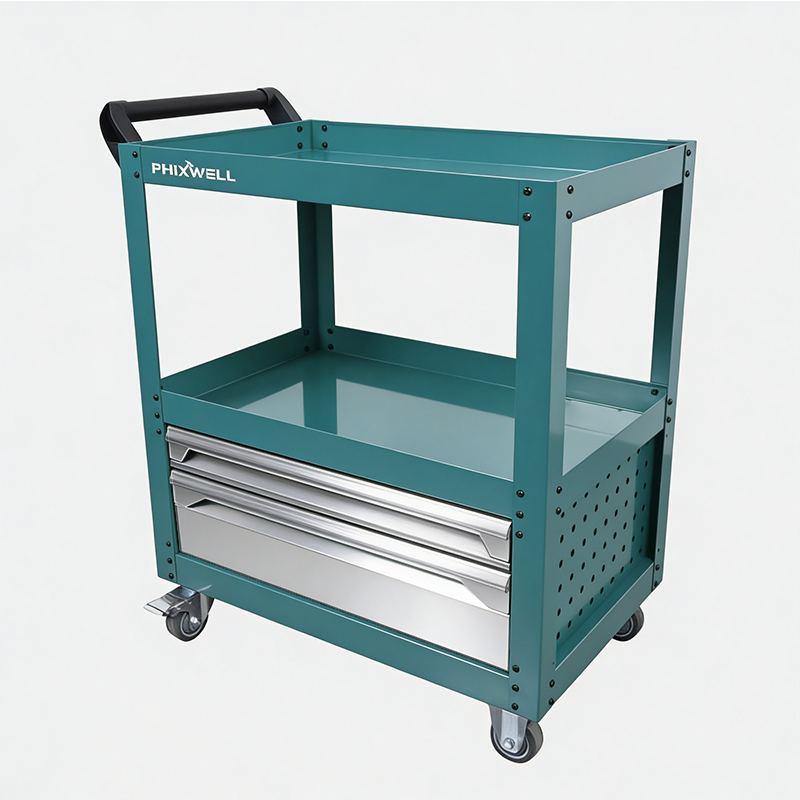
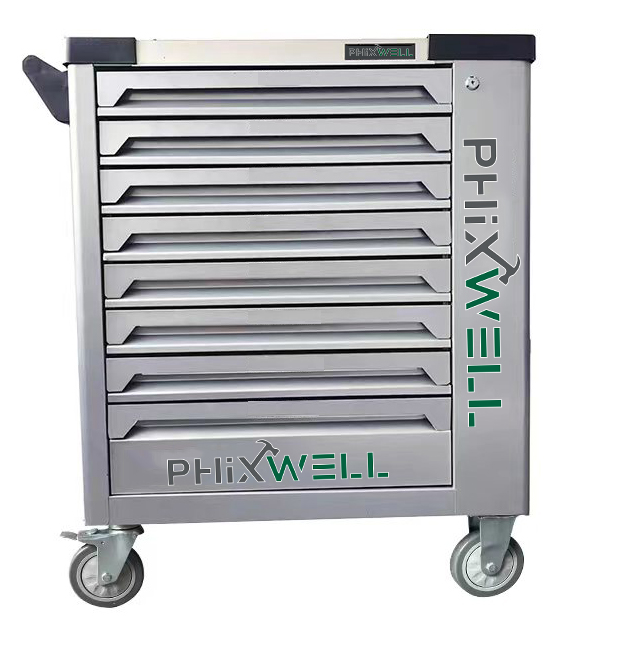
A tool cart with drawer is a mobile storage unit designed for organizing, transporting, and protecting hand tools, power tools, and accessories in workshop, industrial, and maintenance environments. These systems combine vertical drawer storage with wheeled mobility, enabling technicians to move entire tool collections directly to job sites rather than making repeated trips to stationary toolboxes. Standard configurations range from compact two-drawer units measuring 600mm in height to comprehensive seven-drawer systems exceeding 1000mm in overall dimension.
The defining characteristic separating tool carts from basic utility carts lies in the enclosed drawer mechanism. Drawers provide secure, dust-protected storage with individual weight ratings typically between 25 kg and 45 kg per drawer, while open-shelf alternatives expose tools to contamination and potential damage. This enclosed design proves essential for precision instruments, electronic diagnostic equipment, and calibrated measuring tools requiring environmental protection.

Durability and load capacity of tool carts with drawers depend fundamentally on material selection, gauge thickness, and manufacturing precision. Industrial-grade units utilize construction methods that withstand decades of daily use in demanding environments.
| Component | Material | Thickness/Specification | Load Capacity |
|---|---|---|---|
| Cabinet Body | Cold-rolled steel | 0.8-1.2mm | Structural integrity |
| Drawer Slides | Steel ball bearing | 45-55mm width | 35-50 kg per pair |
| Work Surface | Steel with rubber mat | 1.0-1.5mm steel | 200-300 kg distributed |
| Casters | Polyurethane on steel | 100-125mm diameter | 100-150 kg per caster |
| Drawer Bodies | Galvanized steel | 0.6-0.8mm | 25-45 kg per drawer |
Full-extension ball bearing slides represent the industry standard for professional tool carts, allowing drawers to extend 100% of their depth for complete access to rear contents. These systems utilize hardened steel balls circulating in precision-machined races, providing smooth operation under full rated loads. High-end implementations feature soft-close dampeners that prevent drawer slamming and anti-tip interlocks preventing multiple drawers from opening simultaneously, which could cause cart instability.
Tool carts with drawers accommodate diverse tool collections through varied drawer heights, quantities, and internal configurations. Selecting appropriate arrangements maximizes storage density while maintaining tool accessibility.
Common layouts include combinations of shallow drawers (50-75mm height) for small hand tools and fasteners, medium drawers (100-150mm) for power tools, and deep drawers (200mm+) for bulky equipment. A typical five-drawer cart might feature two shallow drawers at top, two medium drawers in the middle, and one deep bottom drawer. This graduated sizing places frequently accessed small items at ergonomic heights while storing heavy equipment low for stability.
Customizable drawer interiors include molded plastic organizers with specific cavities for socket sets, wrench collections, and screwdriver assortments. Foam inlay systems allow users to create custom tool shadows that indicate missing items and prevent movement during cart transport. Some configurations incorporate lockable compartments for valuable instruments or hazardous materials requiring access control.
The mobility component distinguishes tool carts from stationary tool chests, requiring careful caster selection based on floor surfaces, load requirements, and environmental conditions.
Industrial tool carts utilize casters with load ratings significantly exceeding actual weights to ensure smooth rolling over obstacles and floor imperfections. A fully loaded cart weighing 200 kg requires casters rated minimum 75 kg each (300 kg total) to provide safety margins and prevent bearing fatigue. Wheel diameter affects obstacle clearance; 125mm wheels roll over expansion joints and threshold transitions that stall 75mm wheels. Swivel casters on all four corners provide maneuverability in tight spaces, while two rigid and two swivel casters offer directional stability for long-distance transport.
Polyurethane wheels suit concrete and epoxy-coated industrial floors, providing non-marking operation and chemical resistance. Rubber wheels offer superior traction on smooth surfaces but degrade faster under oil exposure. Phenolic resin wheels withstand extreme temperatures and heavy loads but transmit more vibration. For rough or debris-covered floors, pneumatic or semi-pneumatic tires absorb impacts but add maintenance requirements and reduce load capacity.
Implementing tool carts with drawers generates measurable productivity improvements by reducing tool retrieval time, minimizing physical strain, and organizing workspace layouts.
Studies in manufacturing maintenance departments indicate technicians spend 15-20% of work time locating and retrieving tools from centralized storage. Mobile tool carts reduce this overhead by 60-75%, delivering tools directly to job locations. For a technician earning $30 hourly, this efficiency gain translates to $3.60-$4.50 daily savings, recovering tool cart investment within 6-12 months depending on configuration costs.
Properly configured tool carts position frequently used tools between knee and shoulder height, eliminating bending and reaching motions that cause musculoskeletal strain. The work surface provides a stable platform for tool preparation and subassembly operations at comfortable working heights. Weight distribution across four wheels reduces push forces by 70% compared to dragging toolboxes, complying with ergonomic guidelines for manual material handling.
Protecting valuable tool investments requires security measures integrated into cart design, particularly in shared workshop environments or facilities with multiple shifts.
Central locking systems engage all drawers simultaneously through a single key turn, preventing unauthorized access while allowing quick securing during breaks or shift changes. Tubular cam locks provide basic security suitable for general workshop use, while disc detainer or pin tumbler locks offer higher resistance to picking for environments with security concerns. Electronic keypad locks eliminate key management issues and provide audit trails of access in high-security applications.
Beyond drawer locks, comprehensive security includes mounting provisions for cable locks securing the entire cart to fixed structures overnight. Some industrial facilities implement tool shadowing systems with check-out logs, where tool cart drawers contain specific inventories checked at shift changes. GPS tracking devices hidden in cart frames enable location recovery for high-value mobile units used across large facilities or construction sites.
Different sectors adapt tool cart with drawer configurations to address specialized requirements ranging from cleanroom compatibility to explosive atmosphere safety.
Automotive technicians require tool carts accommodating heavy impact wrenches, diagnostic scanners, and specialized pullers. Configurations feature reinforced drawers rated 50+ kg, power strip integration for charging cordless tools, and pry bar holders on cart sides. Oil-resistant casters withstand petroleum contamination common in service bays. Top work surfaces incorporate stainless steel or chemical-resistant coatings for cleaning solvent compatibility.
Biomedical engineering and laboratory maintenance utilize stainless steel tool carts with sealed drawer systems preventing contamination accumulation. Electropolished surfaces eliminate crevices where bacteria colonize, while antimicrobial powder coatings inhibit pathogen growth on handles and work surfaces. These units comply with FDA and Joint Commission standards for equipment used in patient care areas or pharmaceutical manufacturing.
Aerospace tool carts incorporate shadow foam cutouts precisely matching calibrated torque wrenches and measurement instruments, ensuring Foreign Object Debris (FOD) prevention. ESD-safe configurations feature conductive casters and grounded work surfaces protecting sensitive electronics. Weight tracking systems monitor tool presence, preventing tools from being inadvertently left inside aircraft assemblies during maintenance operations.
Evaluating tool cart with drawer options requires systematic assessment of intended use patterns, environmental conditions, and total cost of ownership beyond initial purchase price.
Calculate total tool weight including future acquisitions, then select carts with 50% capacity margin above current requirements. A technician with 80 kg of tools should choose a cart rated 120 kg minimum. This margin accommodates tool accumulation over time and prevents caster bearing wear that occurs when operating near maximum ratings. Consider dynamic loads from rolling over obstacles, which momentarily increase forces on individual casters.
Premium tool carts feature fully welded seams rather than spot-welded or bolted construction, providing superior rigidity under load. Drawer slide specifications should indicate cycle testing results; quality slides endure 50,000+ open-close cycles without degradation. Warranty terms serve as quality proxies, with professional-grade units carrying 5-10 year structural warranties and lifetime slide guarantees. Examine replacement parts availability, as caster and slide wear eventually requires maintenance regardless of initial quality.
Proper maintenance extends tool cart service life from typical 5-7 years to 15+ years, maximizing return on investment and preventing unexpected failures during critical operations.
Monthly maintenance includes caster inspection for debris entanglement and bearing lubrication with light machine oil. Drawer slide tracks require cleaning to remove metal chips and abrasive dust that accelerate wear. Lock mechanisms benefit from graphite lubrication preventing key sticking. Quarterly inspections should examine weld integrity at caster mounts and handle attachments, addressing stress cracks before catastrophic failure.
Casters represent the highest-wear components, typically requiring replacement every 3-5 years in industrial environments. Maintaining spare casters prevents downtime when failures occur. Drawer slides last 7-10 years under normal use but degrade faster if consistently overloaded. Replacement slide installation requires precise alignment to prevent binding; professional installation ensures proper function. Cabinet repainting or powder coating every 10 years addresses cosmetic corrosion and maintains professional appearance.
2026-04-03
2026-04-03
A tool storage cabinet is a freestanding or wall-mounted enclosure designed to organize, protect, and provide controlled access to hand tools, power tools, measuring instruments, and workshop consumables. Unlike open shelving or pegboards, a tool storage cabinet encloses its contents behind doors or drawers, protecting tools from dust, moisture, and unauthorized access while keeping a workshop, garage, or industrial facility organized and safe.
The primary value of a dedicated tool cabinet is not storage capacity alone — it is the systematic organization it imposes. In professional environments, a technician losing 10–15 minutes per shift searching for misplaced tools represents a measurable productivity loss. In aviation maintenance, automotive service, and medical equipment repair, tool control systems built around locked cabinets are mandatory precisely because an unaccounted tool left inside equipment can cause catastrophic failure. For home workshops, the discipline of a dedicated cabinet prevents the tool creep that gradually distributes wrenches across three rooms and two vehicles.

Tool cabinets are available in several distinct formats, each suited to different storage volumes, mobility requirements, and workshop layouts.
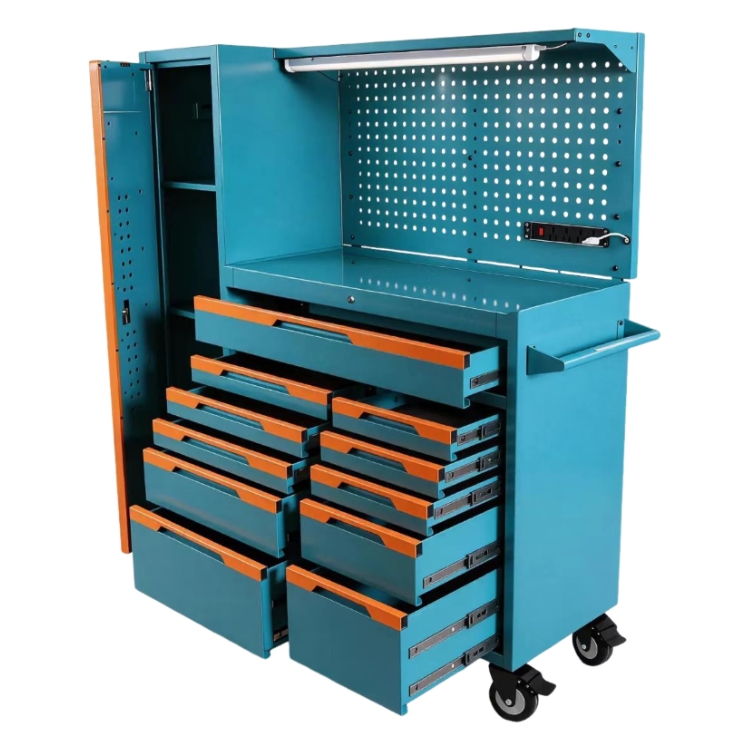
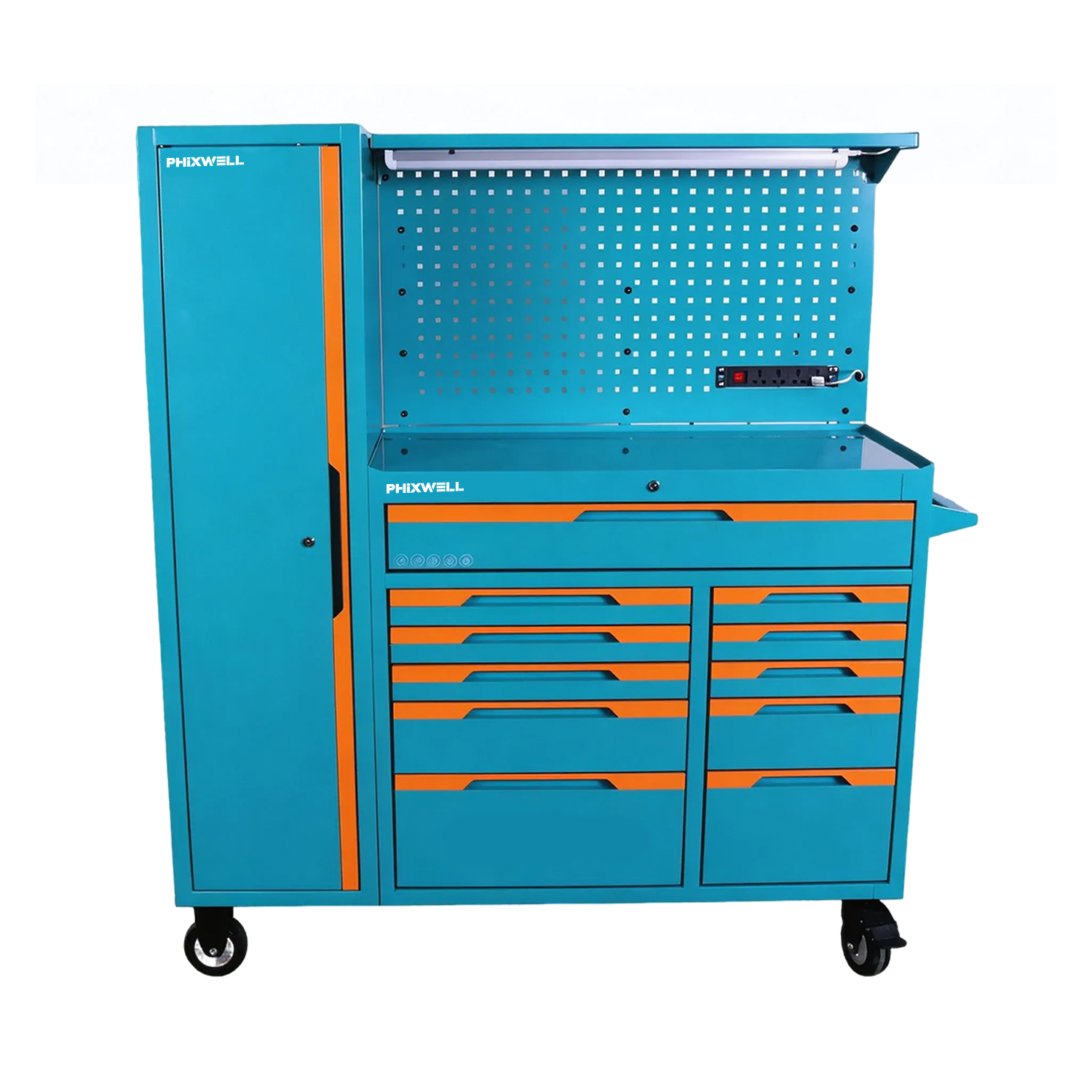
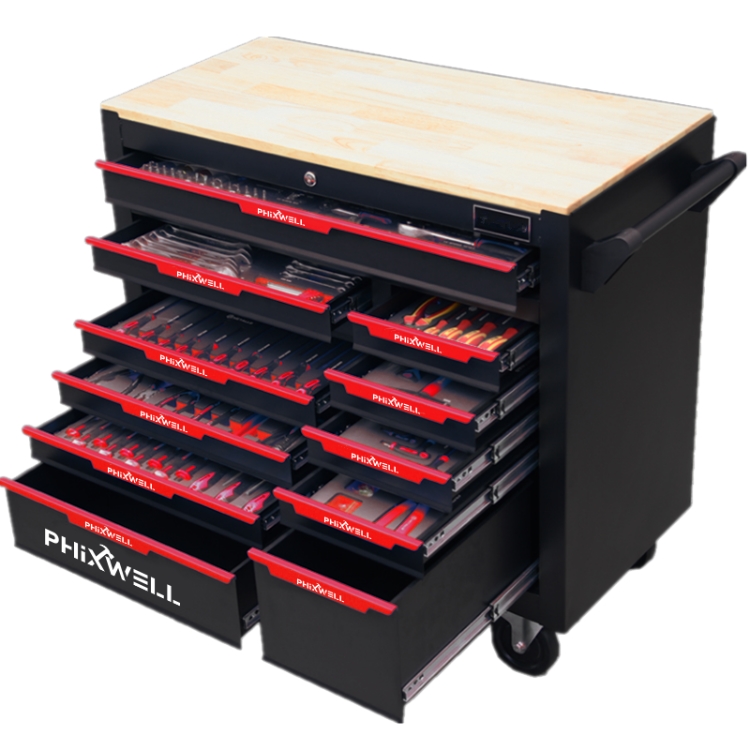
The most prevalent format in professional automotive and mechanical workshops. A rolling tool cabinet combines a lower chest — typically 5 to 15 drawers mounted on heavy-duty casters — with an upper hutch or top chest that sits on the work surface of the lower unit. The mobility allows the cabinet to be positioned directly at the vehicle or machine being serviced, reducing walking distance and keeping tools within arm's reach during complex jobs. Professional-grade rolling cabinets from brands such as Snap-on, Cornwell, and Matco support drawer weight ratings of 45–100 kg per drawer, reflecting the density of large socket sets, torque wrenches, and power tool batteries stored in active service environments.
Wall-mounted cabinets preserve floor space by fixing storage to the workshop wall at a convenient working height. They typically feature hinged or sliding doors that open to reveal a combination of shelves, drawer units, hooks, and panel boards for hanging tools. This format is widely used in home garages, maintenance workshops, and industrial tool cribs where floor space is at a premium and tools need to be accessible without moving a heavy cabinet. Heavier steel wall-mounted cabinets require stud or masonry anchoring rated for the expected load — a fully equipped steel cabinet can weigh 80–150 kg when loaded.
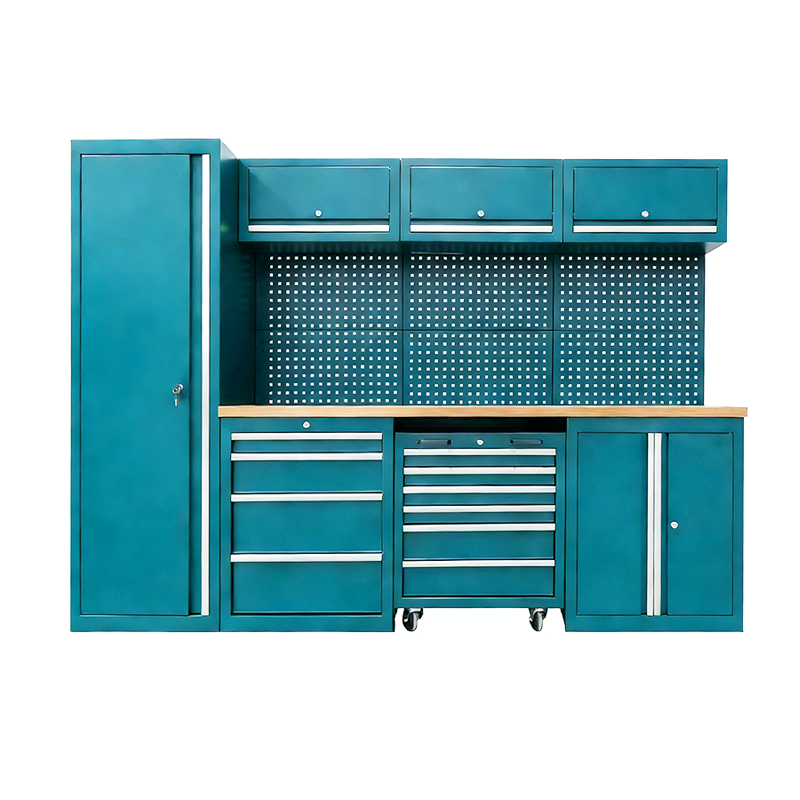
Large freestanding floor cabinets without casters are used where the storage volume exceeds what a rolling chest can accommodate, and where the cabinet's position is permanent. Common in industrial tool cribs, maintenance departments, and production facilities, these units may feature full-height double doors opening to adjustable shelving, combined with lower drawer banks. Modular versions allow sections to be bolted together as storage requirements grow, creating a continuous wall of organized tool storage.
Smaller cabinets — desktop units, under-bench drawers, and compact rolling carts — serve technicians who need a subset of tools at a specific workstation without the full footprint of a professional chest. These are common in electronics repair, HVAC service, and light assembly environments where the tool complement is smaller and more specialized than a general mechanical workshop.
| Cabinet Type | Mobility | Typical Capacity | Best For |
|---|---|---|---|
| Rolling chest | High | Medium – large | Auto/mechanical workshops |
| Wall-mounted cabinet | None (fixed) | Small – medium | Garages, small workshops |
| Stationary floor cabinet | None (fixed) | Large – very large | Industrial tool cribs, MRO |
| Portable / compact cart | High | Small | Field service, light assembly |
The material and gauge of a tool storage cabinet determines its load capacity, resistance to denting and corrosion, service life, and price. The three dominant materials in the market are cold-rolled steel, stainless steel, and high-density polyethylene (HDPE).
The standard material for professional and industrial tool cabinets. Steel gauge is the single most important quality indicator — professional cabinets use 16–18 gauge steel (1.2–1.5 mm) for drawer bodies and cabinet walls, while budget units use 20–22 gauge (0.8–0.9 mm) that dents under normal workshop use. The powder coat finish applied over the steel determines corrosion resistance: quality powder coats are 60–80 microns thick, applied over a phosphate conversion coating that provides an additional corrosion barrier. In workshop environments with frequent solvent or oil exposure, the powder coat's chemical resistance matters as much as its mechanical toughness.
Used in food processing, pharmaceutical, and cleanroom environments where chemical resistance and cleanability are mandatory. Stainless steel tool cabinets are substantially more expensive than carbon steel equivalents and are not necessary in general workshop environments, but they are the correct specification where regular washdown with aggressive cleaning agents occurs or where contamination control standards apply.
High-density polyethylene cabinets are lightweight, completely rust-proof, and resistant to most workshop chemicals. They are well-suited to outdoor storage, marine environments, and applications where corrosion is the primary concern. Their limitation is structural rigidity — HDPE cabinets cannot match the drawer weight ratings of heavy-gauge steel units, and they are not suitable for the heaviest professional tool collections.
Beyond material and format, several specific features distinguish a cabinet that performs well over years of daily use from one that deteriorates quickly under professional conditions.
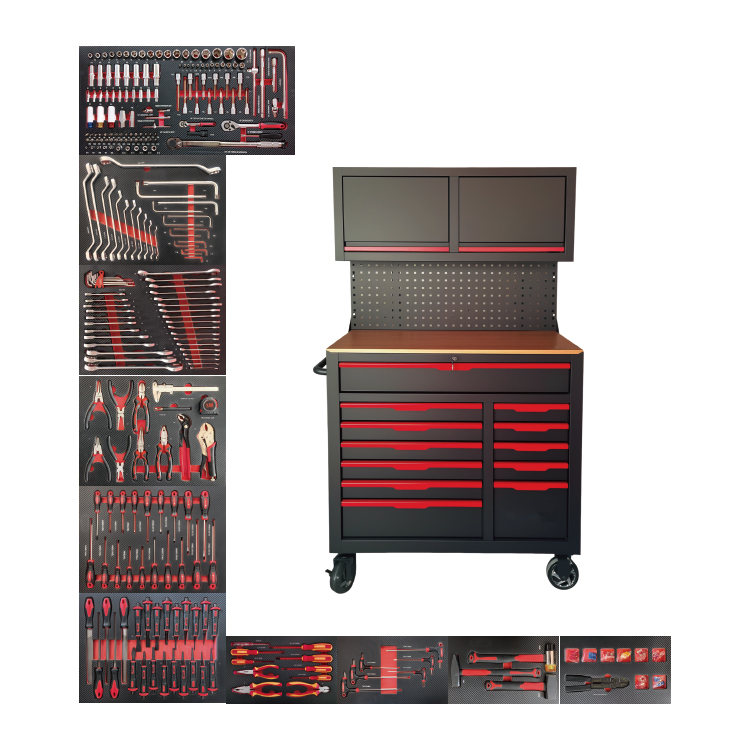
Tool cabinets sold pre-loaded with a tool set represent a significant portion of the consumer and mid-professional market. These packages typically combine a rolling chest or compact cabinet with a general-purpose mechanic's tool set — sockets, wrenches, screwdrivers, pliers, and ratchets — organized in the drawers with foam inserts or tray organizers. They are targeted at homeowners setting up a first workshop, light hobbyists, and tradespeople establishing a new mobile service kit.
The practical consideration when evaluating a tool cabinet with tools is whether the included tool set matches the
2026-02-22
A professional workshop demands robust organizational solutions, and a Garage Storage Combination Cabinet is essential for maximizing efficiency. When assessing the functionality of these units, the primary technical consideration is the structural integrity and load-bearing capacity of the individual shelves. For engineers and workshop managers, understanding the industrial garage storage combination cabinet load capacity is critical to preventing structural failure and ensuring workplace safety. Generally, a high-quality steel shelf can support between 100 lbs and 300 lbs, depending heavily on the steel gauge, reinforcement design, and load distribution. This article provides a technical analysis of the factors determining these limits.
The total weight capability of a Garage Storage Combination Cabinet is not uniform; it is dictated by the structural properties of the materials used. The thickness of the steel, measured in gauge, is the most significant factor. steel garage cabinet shelf weight limit specifications are directly proportional to the steel thickness.
Industrial-grade cabinets typically utilize 18-gauge to 22-gauge steel for the frame and shelves. Thicker steel (lower gauge number) provides higher rigidity and load capacity. Additionally, reinforcement ribs welded or bolted underneath the shelf increase the capacity without drastically increasing the cabinet's weight. heavy duty garage storage system installation requires verifying these specifications to ensure the unit can handle the intended load.
It is important to differentiate between static load (weight at rest) and dynamic load (weight during movement). For stationary units, the best garage cabinets for heavy tools leverage reinforced steel to support high static loads. modular garage storage cabinets vs stationary units: modular cabinets often have lower load limits per shelf compared to fully welded stationary units due to the structural compromise of the joints and connectors.
| Steel Gauge | Shelf Thickness | Typical Shelf Capacity (lbs) |
| 18 Gauge | 1.2 mm | 200 - 300 |
| 20 Gauge | 0.9 mm | 150 - 200 |
| 22 Gauge | 0.7 mm | 100 - 150 |
How tools are placed on the shelf significantly impacts safety. Concentrated loads in the center of a shelf create high stress, whereas evenly distributed loads allow the shelf to reach its maximum rated capacity.
Fixed shelves provide higher structural stability because they are welded to the cabinet frame, acting as structural members themselves. Adjustable shelves, conversely, rely on clips or pins, which can become weak points under extreme loads. garage storage cabinet safety features often include heavy-duty shelf pins to mitigate this risk.
Reinforcement structures, such as full-width support channels under the shelf, are essential for heavy duty garage storage system installation. Without proper reinforcement, steel shelves are prone to deflection, which can lead to eventual collapse. garage cabinet gauge steel comparison: cabinets utilizing 18-gauge steel with reinforcement ribs support 50% more weight than unreinforced 18-gauge shelves.
A garage environment is often subject to humidity, temperature fluctuations, and exposure to chemicals. Therefore, the longevity of the Garage Storage Combination Cabinet depends on its surface treatment.
For longevity in damp environments, powder coating is superior to conventional liquid paint. rust resistant garage storage systems utilize a multi-stage process where steel is cleaned, phosphate-coated, and then powder-coated to ensure maximum adhesion and protection against oxidation. When how to organize a workshop with cabinets, ensuring the coating is intact is crucial to maintain structural integrity over time.
Security is another factor for Garage Storage Combination Cabinet selection. lockable garage storage cabinets security requires a multi-point locking system that secures both the top and bottom of the doors, preventing pry bar access. The structural robustness of the locking mechanism is also tested against forced entry, ensuring that best garage cabinets for heavy tools also serve as secure storage for expensive diagnostic equipment.
| Feature | Industrial Standard | Commercial Standard |
| Coating | Powder-Coated | Liquid Paint |
| Locking System | 3-Point Locking | Single-Point Locking |
| Shelf Gauge | 18 - 20 Gauge | 20 - 22 Gauge |
When selecting a Garage Storage Combination Cabinet, it is helpful to contrast the performance of different designs.
Understanding the weight capacity of a Garage Storage Combination Cabinet involves more than just reading the manufacturer's maximum rating. It requires an engineering analysis of the steel gauge, reinforcement techniques, and the type of load being stored. For professional industrial workshops, selecting units constructed from 18-gauge steel with reinforced shelves provides the necessary safety and durability for heavy-duty applications. Always ensure the heavy duty garage storage system installation adheres to safe practices, including evenly distributing weight and securing the unit to the floor or wall.
Residential cabinets typically range from 50 lbs to 100 lbs per shelf, as they are not designed for heavy industrial tools.
You can increase capacity by installing additional support channels beneath the shelf or by adding extra shelf pins for adjustable shelves, provided the pins are rated for the increased load.
No, plastic cabinets generally have lower shelf weight limits compared to steel and are prone to warping under heavy, long-term loads or high heat.
No, adjustable shelves usually have a lower load limit because they rely on pins or clips rather than being welded to the cabinet structure.
Yes, anchoring is essential to prevent tipping, especially when the unit is loaded with heavy tools or when lockable garage storage cabinets security features are engaged and doors are opened.
2026-02-15
A professional workshop demands robust organizational solutions, and a Garage Storage Combination Cabinet is essential for maximizing efficiency. When assessing the functionality of these units, the primary technical consideration is the structural integrity and load-bearing capacity of the individual shelves. For engineers and workshop managers, understanding the industrial garage storage combination cabinet load capacity is critical to preventing structural failure and ensuring workplace safety. Generally, a high-quality steel shelf can support between 100 lbs and 300 lbs, depending heavily on the steel gauge, reinforcement design, and load distribution. This article provides a technical analysis of the factors determining these limits.
The total weight capability of a Garage Storage Combination Cabinet is not uniform; it is dictated by the structural properties of the materials used. The thickness of the steel, measured in gauge, is the most significant factor. steel garage cabinet shelf weight limit specifications are directly proportional to the steel thickness.
Industrial-grade cabinets typically utilize 18-gauge to 22-gauge steel for the frame and shelves. Thicker steel (lower gauge number) provides higher rigidity and load capacity. Additionally, reinforcement ribs welded or bolted underneath the shelf increase the capacity without drastically increasing the cabinet's weight. heavy duty garage storage system installation requires verifying these specifications to ensure the unit can handle the intended load.
It is important to differentiate between static load (weight at rest) and dynamic load (weight during movement). For stationary units, the best garage cabinets for heavy tools leverage reinforced steel to support high static loads. modular garage storage cabinets vs stationary units: modular cabinets often have lower load limits per shelf compared to fully welded stationary units due to the structural compromise of the joints and connectors.
| Steel Gauge | Shelf Thickness | Typical Shelf Capacity (lbs) |
| 18 Gauge | 1.2 mm | 200 - 300 |
| 20 Gauge | 0.9 mm | 150 - 200 |
| 22 Gauge | 0.7 mm | 100 - 150 |
How tools are placed on the shelf significantly impacts safety. Concentrated loads in the center of a shelf create high stress, whereas evenly distributed loads allow the shelf to reach its maximum rated capacity.
Fixed shelves provide higher structural stability because they are welded to the cabinet frame, acting as structural members themselves. Adjustable shelves, conversely, rely on clips or pins, which can become weak points under extreme loads. garage storage cabinet safety features often include heavy-duty shelf pins to mitigate this risk.
Reinforcement structures, such as full-width support channels under the shelf, are essential for heavy duty garage storage system installation. Without proper reinforcement, steel shelves are prone to deflection, which can lead to eventual collapse. garage cabinet gauge steel comparison: cabinets utilizing 18-gauge steel with reinforcement ribs support 50% more weight than unreinforced 18-gauge shelves.
A garage environment is often subject to humidity, temperature fluctuations, and exposure to chemicals. Therefore, the longevity of the Garage Storage Combination Cabinet depends on its surface treatment.
For longevity in damp environments, powder coating is superior to conventional liquid paint. rust resistant garage storage systems utilize a multi-stage process where steel is cleaned, phosphate-coated, and then powder-coated to ensure maximum adhesion and protection against oxidation. When how to organize a workshop with cabinets, ensuring the coating is intact is crucial to maintain structural integrity over time.
Security is another factor for Garage Storage Combination Cabinet selection. lockable garage storage cabinets security requires a multi-point locking system that secures both the top and bottom of the doors, preventing pry bar access. The structural robustness of the locking mechanism is also tested against forced entry, ensuring that best garage cabinets for heavy tools also serve as secure storage for expensive diagnostic equipment.
| Feature | Industrial Standard | Commercial Standard |
| Coating | Powder-Coated | Liquid Paint |
| Locking System | 3-Point Locking | Single-Point Locking |
| Shelf Gauge | 18 - 20 Gauge | 20 - 22 Gauge |
When selecting a Garage Storage Combination Cabinet, it is helpful to contrast the performance of different designs.
Understanding the weight capacity of a Garage Storage Combination Cabinet involves more than just reading the manufacturer's maximum rating. It requires an engineering analysis of the steel gauge, reinforcement techniques, and the type of load being stored. For professional industrial workshops, selecting units constructed from 18-gauge steel with reinforced shelves provides the necessary safety and durability for heavy-duty applications. Always ensure the heavy duty garage storage system installation adheres to safe practices, including evenly distributing weight and securing the unit to the floor or wall.
Residential cabinets typically range from 50 lbs to 100 lbs per shelf, as they are not designed for heavy industrial tools.
You can increase capacity by installing additional support channels beneath the shelf or by adding extra shelf pins for adjustable shelves, provided the pins are rated for the increased load.
No, plastic cabinets generally have lower shelf weight limits compared to steel and are prone to warping under heavy, long-term loads or high heat.
No, adjustable shelves usually have a lower load limit because they rely on pins or clips rather than being welded to the cabinet structure.
Yes, anchoring is essential to prevent tipping, especially when the unit is loaded with heavy tools or when lockable garage storage cabinets security features are engaged and doors are opened.
2026-02-08
In the demanding environment of an industrial workshop, the ability to store, organize, and transport heavy machinery components and precision instruments safely is paramount. A Mobile Tool Storage Cabinet is not just a storage unit; it is a critical piece of infrastructure designed to enhance productivity. However, understanding the industrial mobile tool cabinet load capacity is essential to prevent structural failures, equipment damage, or personnel injury. A truly heavy-duty unit can support a total capacity ranging from 1,000 lbs to over 3,000 lbs, but this limit is strictly dictated by its components and design engineering.
The total weight a Mobile Tool Storage Cabinet can hold is not a single number; it is the sum of the load capabilities of the drawer system, the main chassis frame, and the caster assemblies. Industrial engineers must look at the overall structural integrity tool trolley steel used, which is typically high-gauge, cold-rolled steel.
The total capacity is often limited by the individual drawer ratings. It is a common misconception that all drawers in a cabinet have the same limit. For instance, top drawers designed for lighter hand tools may have a 50 lb limit, while lower drawers designed for heavy socket sets or diagnostic equipment can support 150 lbs to 300 lbs each.
When comparing drawer slide technologies, ball-bearing slides offer significantly higher load capabilities and durability than friction-based slides. Industrial tool cabinet drawer dividers also add structural reinforcement to the drawers themselves.
| Drawer Type | Slide Technology | Weight Capacity per Drawer |
| Shallow Drawer | Ball-Bearing | 50 - 75 lbs |
| Medium Drawer | Heavy-Duty Ball-Bearing | 100 - 150 lbs |
| Deep Drawer | Reinforced Ball-Bearing | 200 - 300 lbs |
The mobility of a Mobile Tool Storage Cabinet relies entirely on its casters. The total load capacity of the cabinet cannot exceed the combined capacity of its four casters. It is critical to select best casters for heavy load tool cabinet applications, typically featuring polyurethane treads on iron cores, which prevent wheel deformation under constant heavy static loads.
How the weight is distributed within the Mobile Tool Storage Cabinet is as important as the total weight itself. Engineering design plays a significant role in safe load distribution.
The chassis frame must be reinforced to prevent twisting or sagging when moving over uneven workshop floors. High-capacity cabinets often utilize a double-wall construction and reinforced corner gussets. Comparing steel gauges, a 14-gauge steel frame provides vastly superior strength and resistance to deformation under load compared to an 18-gauge frame.
Key technical specifications to review for industrial mobile tool cabinet load capacity include:
Operating a heavy Mobile Tool Storage Cabinet requires adherence to strict safety guidelines to ensure workplace compliance and safety.
Industrial settings necessitate that heavy equipment complies with OSHA or equivalent regional standards. A primary safety feature is a drawer interlock system, which ensures that only one drawer can be opened at a time. This prevents the cabinet from becoming top-heavy and tipping over, a major safety risk when how to calculate tool cabinet load limit incorrectly.
For high-capacity storage, a stationary chest can generally support more weight than a Mobile Tool Storage Cabinet, as it does not rely on caster ratings. However, a stationary unit loses the efficiency benefits of mobile tool storage cabinet mobility.
| Feature | Mobile Tool Cabinet | Stationary Tool Chest |
| Mobility | High | None |
| Maximum Capacity | Limited by Casters | Limited by Frame |
| Safety Risk | Tipping Hazard | Low |
The maximum load capacity of a Mobile Tool Storage Cabinet in an industrial workshop is a complex calculation involving the drawer slides, frame structural integrity, and, most importantly, the caster specifications. A well-engineered heavy duty tool chest drawer weight limit system, combined with robust casters, allows for a total capacity upwards of 2,000 lbs. Understanding these specs ensures safe operation, enhances organization, and maximizes the longevity of your industrial storage solutions.
No. Exceeding the maximum capacity can cause caster failure, drawer slide collapse, or frame deformation, leading to severe safety hazards and equipment damage.
Look for high-capacity polyurethane on iron or steel core wheels. Ensure they have total-lock brakes that secure both the wheel rotation and the swivel mechanism.
Yes. Dynamic load capacity refers to the weight the cabinet can safely carry while moving, which is always lower than the static load capacity when stationary.
Drawer interlock is a safety feature that prevents multiple drawers from being opened simultaneously, keeping the cabinet's center of gravity stable and preventing tipping.
Drawer dividers must be compatible with the specific manufacturer's drawer dimensions and locking mechanism to provide proper structural reinforcement.
2026-02-01
In a professional workshop or industrial setting, organization and accessibility are paramount. A Tool Cart With Drawers is not merely a storage unit; it is a mobile workstation designed to streamline productivity. However, the true value of such equipment lies in its structural integrity. Understanding the load limits is critical for worker safety and tool protection. A typical heavy duty tool cart load capacity ranges from 500 lbs to over 2,000 lbs depending on the engineering standards. This article provides an engineer-level analysis of how much weight these units can safely support, considering structural components, caster limits, and safe operational practices.
The total weight a Tool Cart With Drawers can hold is primarily determined by its construction material and design. Most heavy-duty carts are constructed from cold-rolled steel, which offers high tensile strength. Engineers must evaluate the gauge of the steel used in both the frame and the tool drawer storage units. A stronger frame means the cart can handle more weight without buckling.
| Material/Design Component | Load Support Capability |
| 18-Gauge Steel Frame | Up to 500 lbs |
| 16-Gauge Steel Frame | 500 - 1,000 lbs |
| 14-Gauge Steel Frame | 1,000+ lbs |
| Fully Welded Body | Maximum Structural Rigidity |
The weight capacity of individual drawers is crucial for organizing heavy tools like socket sets, impact wrenches, and specialized diagnostic equipment. Drawer slide weight capacity determines how much weight a drawer can hold while opening and closing smoothly. Ball-bearing slides are the standard in professional environments, offering superior performance compared to friction slides.
For demanding applications, industrial tool storage specs often mandate heavy-duty ball-bearing slides that can support substantial weight at full extension.
| Drawer Slide Type | Weight Limit Per Drawer | Best Use Case |
| Friction Slides | 25 - 50 lbs | Lightweight Tools |
| Standard Ball-Bearing | 75 - 100 lbs | General Workshop |
| Heavy-Duty Ball-Bearing | 150 - 400 lbs | Heavy Machinery Tools |
The total weight capacity is also limited by the weakest component, which is frequently the casters. The casters must support the weight of the cart itself (dead load) plus the tools stored within (live load). When moving a fully loaded tool cart, the dynamic load—the stress placed on the wheels while in motion—is significantly higher than the static load (weight at rest).
Even a cart rated for 2,000 lbs can fail if loaded improperly. Engineers recommend distributing weight evenly, with the heaviest tools placed in the lower drawers to keep the center of gravity low. Why is tool cart stability important? Because an unstable cart can tip over, causing injury to personnel and damage to equipment. When comparing mobile vs stationary tool cabinets, it is clear that mobility requires stricter weight management protocols.
Selecting the right Tool Cart With Drawers requires understanding both the static and dynamic load capacity of the unit. A high-quality, heavy-duty cart can comfortably support over 1,500 lbs, provided it is constructed from heavy-gauge steel, utilizes heavy-duty ball-bearing slides, and is equipped with appropriately rated casters. Always refer to the manufacturer's technical specifications to ensure safe operation within a professional workshop environment.
No. Exceeding the load capacity can cause structural failure of the frame, broken drawer slides, or caster failure, leading to safety hazards.
Placing heavy tools in the top drawers raises the center of gravity, making the cart unstable and prone to tipping over when moved.
Static load is the weight the cart can hold while stationary. Dynamic load is the weight it can safely hold and move over a surface.
Yes. Locking casters are essential to ensure the cart remains stationary while working on it, preventing accidental movement.
A Tool Cart With Drawers is superior for heavy tools because drawers provide secure, organized storage and drawer slides are specifically engineered to handle heavy loads smoothly.
2026-01-21
For any automotive enthusiast or professional mechanic, tools are more than just equipment—they are investments and extensions of skill. However, these valuable assets are only as effective as their accessibility and condition allow. A cluttered workspace with tools scattered across benches, floors, and various small boxes is a recipe for frustration, lost time, and even safety hazards. This is where transitioning from a simple toolbox to a dedicated Auto Repair Cabinet becomes a game-changing decision. A purpose-built cabinet does far more than store tools; it organizes, protects, and systematizes your entire workflow. Investing in a proper storage solution transforms your garage or shop from a chaotic area into a streamlined, professional-grade environment. It directly contributes to increased productivity, as technicians spend less time searching for tools and more time applying them. Furthermore, it safeguards your tools from damage, dust, and moisture, significantly extending their lifespan and protecting your financial investment. Ultimately, the right cabinet is not an expense but a foundational component of a safe, efficient, and scalable operation.
Selecting the ideal Auto Repair Cabinet requires careful evaluation of your specific needs and the environment it will serve. Rushing this decision can lead to purchasing an unit that is either insufficient for your tool collection or wasteful of your space and budget. The first and most critical step is conducting an honest assessment of your current and anticipated future tool inventory. Consider not just the number of tools, but their size, weight, and shape—long wrenches, bulky power tools, and delicate diagnostic equipment all have different storage demands. Simultaneously, meticulously measure your available floor and wall space, considering door swings, vehicle clearance, and workflow pathways. The goal is to find a cabinet that offers maximal storage density without impeding movement in your workshop. Understanding these core parameters of scale and scope will guide you towards the correct type, size, and configuration of cabinet, ensuring it serves as a long-term asset rather than a temporary fix.
The longevity and performance of your cabinet hinge entirely on its construction. The industry standard for professional-grade units is cold-rolled steel, prized for its strength and resistance to warping.
This is where a cabinet's functionality is truly defined. It's not just about the number of drawers, but their dimensions, weight capacity, and layout.
Use the following table to plan your drawer configuration based on common tool types:
| Tool Category | Recommended Drawer Type | Key Considerations |
| Screwdrivers, Pliers, Wrenches | Shallow drawers (2-3" height) with dividers | Organization is key; foam liners or customizable dividers prevent tangling. |
| Socket Sets, Ratchets | Medium-depth drawers (4-6" height) with socket organizers | Organizers by drive size (1/4", 3/8", 1/2") and metric/SAE are crucial. |
| Power Tools (Drills, Impacts, Grinders) | Deep drawers (8-12" height) with high weight capacity | Ensure ample length and width; consider non-slip mats to prevent movement. |
| Long Items (Pry Bars, Hammers, Torque Wrenches) | Full-length deep drawers or dedicated vertical storage | Some cabinets offer end compartments or tall side lockers for this purpose. |
The market offers a variety of cabinet styles, each designed to excel in specific scenarios. From the compact home garage to the bustling professional bay, understanding these types will lead you to your perfect match.
Built to withstand the relentless demands of daily commercial use, these cabinets are the bedrock of a professional auto shop tool storage cabinet system. They prioritize maximum strength, security, and capacity above all else.
The quintessential roll cab tool chest for mechanics combines secure storage with unparalleled mobility. It serves as a portable workstation that brings the tools directly to the job.
A modular automotive workshop storage cabinet system is the ultimate solution for flexibility and future expansion. It typically starts with a main roll cab or base cabinet, to which you can add a top chest, side lockers, end cabinets, or even overhead storage.
These cabinets strike an ideal balance between durability, functionality, and price for the serious DIYer or home mechanic. They bridge the gap between flimsy consumer storage and cost-prohibitive industrial equipment.
While options and accessories are plentiful, certain features are fundamental to the utility and longevity of any quality Auto Repair Cabinet. Compromising on these elements will almost certainly lead to regret as your tools and demands grow.
This is a common point of confusion. Typically, a "tool chest" refers to a smaller, portable box with a hinged lid and one or two trays inside, designed for carrying a basic set of tools. A tool cabinet is a larger, stationary or semi-mobile unit featuring multiple full-extension drawers for comprehensive, organized storage of a complete tool collection. A roll cab tool chest for mechanics often blends the terms, being a mobile cabinet with drawers, but it is fundamentally a cabinet in function and form.
Drawer weight capacity varies dramatically by cabinet quality. For a budget-friendly tool cabinet for home garage repair, drawers may hold 25-50 lbs each. A mid-range heavy duty auto repair tool cabinet will often have ratings of 75-100 lbs per drawer. High-end professional auto shop tool storage cabinet drawers can support 150 lbs, 200 lbs, or even more. Always check the manufacturer's specifications for each individual drawer, as capacities can differ within the same unit.
This depends on your space and flexibility needs. A single large cabinet is often more cost-effective per unit of storage and provides a clean, unified look. However, a modular automotive workshop storage cabinet system offers unparalleled advantages: you can start small and expand precisely as needed, reconfigure the layout if your shop changes, and move smaller units more easily than one massive cabinet. Modularity is the clear winner for future-proofing and adapting to an evolving workspace.
For a cabinet that will last in an auto repair setting, do not settle for anything thinner than 22-gauge steel for the main body. For a truly heavy duty auto repair tool cabinet, aim for 18 or 20-gauge as a sweet spot of strength and value. Drawer fronts and sides on premium models will often be 16-gauge or thicker. Remember, a lower gauge number means thicker, stronger steel. The gauge, combined with the quality of reinforcement and welding, determines the cabinet's resistance to sagging, denting, and overall fatigue.
2026-01-14
In today’s fast-paced work environments, such as auto repair shops, workshops, or construction sites, high-performance tool carts are crucial for productivity, efficiency, and safety. These carts provide easy access to tools, minimize downtime, and reduce the risk of tool loss or damage.
Designed for heavy-duty use, modern tool carts are mobile, secure, and durable, helping workers stay organized while ensuring quick access to tools. Whether you’re in automotive repair, construction, or a DIY project, investing in a quality tool cart can enhance organization and workflow, ultimately boosting productivity.
A high-performance tool cart is a robust and highly durable piece of equipment designed to store, organize, and transport tools efficiently. These carts are constructed with high-strength materials, typically steel, and are built to handle heavy loads without compromising their structure. High-performance tool carts are engineered with a focus on mobility, organization, and long-term durability, making them ideal for a range of work environments, including workshops, automotive repair shops, and construction sites.
Some of the defining features of high-performance tool carts include:
These features make high-performance tool carts an indispensable tool for anyone who works with a variety of equipment and tools daily. Whether you’re storing hand tools, power tools, or specialized accessories, a well-designed tool cart can help keep your workspace organized, improve workflow, and ensure tools are easily accessible.
| Feature | High-Performance Tool Cart | Standard Tool Cart |
|---|---|---|
| Material | High-strength steel, reinforced structure | Standard steel or plastic |
| Load Capacity | 100 kg and above | 50 kg to 100 kg |
| Storage Design | Multi-layered trays, drawers, hooks | Basic trays or single storage space |
| Mobility | High-quality casters, wear-resistant | Standard casters |
| Braking System | Locking mechanism for stability | Usually no braking system |
| Ergonomics | Height-adjustable, user-friendly handles | Basic handle, no ergonomic features |
| Customization | Modular and customizable layouts | Fixed storage space |
| Durability | Long-lasting, designed for industrial use | Suitable for light-duty tasks |
High-performance tool carts come in a wide variety of designs, each designed to meet the specific needs of different industries. Below are the common types of tool carts and the work environments where they are most beneficial.
Automotive repair tool carts are designed to meet the demands of auto mechanics and technicians. These carts are built to handle heavy tools and automotive parts, with features that support the fast-paced and often high-pressure environment of an auto repair shop.
Key Features:
Applications:
Mechanics can store all their tools in one organized space, reducing the time spent searching for the right tool. The cart allows for mobility, so the mechanic can work on multiple vehicles without losing track of tools or equipment.
Multi-functional tool carts are perfect for smaller workshops, DIY enthusiasts, and general-purpose environments. These carts are designed to be flexible, offering storage for a variety of tools across different projects.
Key Features:
Applications:
Ideal for workshops that handle various projects, from woodworking to electrical work. These carts provide easy access to essential tools, improving workflow and reducing clutter.
Heavy-duty tool carts are designed to handle the tough conditions of construction sites. They are built to carry large quantities of heavy tools, with reinforced wheels that can handle rough and uneven terrain.
Key Features:
Applications:
Construction workers need to move large quantities of tools across the site. These heavy-duty carts ensure that tools are securely stored and easily transported, even on uneven ground.
Modular tool carts are customizable and can be adjusted to fit a range of tools. These carts are particularly useful in industrial environments where a variety of specialized tools are used.
Key Features:
Applications:
Manufacturing and assembly line workers can use modular carts to organize tools for specific tasks. The customizable design makes it easy to reconfigure the cart as the work environment evolves.
Mobile tool carts are designed for technicians who move between different work sites. These carts are lightweight, easy to transport, and designed for portability.
Key Features:
Applications:
Field technicians in industries such as HVAC, plumbing, and electrical services rely on these mobile carts to carry their essential tools to different service locations. The ability to easily move the cart from job to job enhances overall efficiency.
Choosing the right tool cart is essential for improving efficiency, organization, and safety. Here’s a quick guide on key factors to consider:
High-performance tool carts offer numerous advantages in both professional and DIY settings. They not only improve efficiency but also ensure that tools are kept organized and secure. Here are some key benefits:
Having a well-organized tool cart with everything in its place significantly reduces the time spent searching for tools. This means less downtime and more focus on completing tasks. Whether you’re working in a fast-paced auto repair shop or managing a construction project, easy access to your tools can save valuable time and improve overall productivity.
Tool carts designed with locking mechanisms and secure compartments help to prevent tools from falling or being misplaced. This reduces the risk of accidents caused by tools being left out or scattered around the workspace. Additionally, tool carts with sturdy wheels and brakes help prevent accidental movement, ensuring that the cart remains stable during work processes.
Tool carts help reduce clutter in the workplace by providing designated storage spaces for each tool. The use of drawers, trays, and hooks ensures that tools are neatly organized and easily accessible, reducing the risk of tool loss and damage. An organized workspace contributes to a safer and more efficient working environment.
The mobility of high-performance tool carts allows users to move their tools from one area to another with ease. Whether it’s a mechanic rolling a cart from one vehicle to another or a construction worker moving tools across a site, the ability to transport tools quickly and efficiently enhances overall workflow.
Maintaining and properly caring for your high-performance tool cart is essential to ensure its longevity, smooth operation, and optimal performance. Regular maintenance not only extends the lifespan of the cart but also ensures that it remains safe and efficient to use. In this section, we will cover the essential maintenance tasks you should perform to keep your tool cart in top condition, as well as tips for handling common issues.
The wheels of a tool cart are one of its most critical components, ensuring that the cart moves smoothly and can support heavy loads. Over time, wheels can become worn down, clogged with debris, or damaged. Regularly inspecting the casters and wheels is important for maintaining mobility.
Maintenance Tips:
Drawers and compartments are vital for organizing tools and keeping them secure. Over time, these drawers can accumulate dirt, grease, or other residues from the tools they hold. Regular cleaning of the drawers and compartments helps to maintain a clean and efficient storage system.
Maintenance Tips:
Regularly checking the bolts, screws, and fasteners on your tool cart is essential for ensuring the structural integrity of the cart. Vibrations and heavy usage can cause these components to loosen, which may affect the cart’s stability.
Maintenance Tips:
To extend the lifespan of your tool cart and prevent unnecessary wear on its wheels and structure, ensure that tools are stored in an organized manner with proper weight distribution.
Maintenance Tips:
If your tool cart is kept outdoors or in a workshop exposed to moisture, dust, or chemicals, it’s important to protect it from environmental damage. Exposure to harsh elements can lead to corrosion, rust, and wear over time.
Maintenance Tips:
The braking system of a tool cart is crucial for ensuring stability when the cart is not in motion. Regularly check the brakes to make sure they are functional and provide the necessary security when the cart is stationary.
Maintenance Tips:
A high-performance tool cart is an essential piece of equipment for any professional or DIY workspace. Whether you are in automotive repair, construction, or general manufacturing, a well-chosen tool cart can significantly improve productivity, organization, and safety. With numerous options available, selecting the right cart for your needs is crucial to maximizing its benefits.
By considering factors such as load capacity, mobility, material quality, and ergonomic design, you can choose a tool cart that will enhance your workflow and stand the test of time. Regular maintenance and care are also key to ensuring that your tool cart remains in top condition for years to come.
High-performance tool carts are built from durable materials like steel and have a higher load capacity, better mobility, and enhanced organization features compared to standard tool carts. They are designed for professional and industrial environments that require heavy-duty performance.
Consider factors like load capacity, mobility, storage design, and material quality. If you work with heavy tools, a high-performance cart with reinforced steel construction and high-quality wheels is recommended. For smaller workshops, a multi-functional or modular cart may be a better fit.
Regular maintenance should be performed every 3-6 months, depending on usage. This includes checking the casters, drawers, and fasteners, cleaning the wheels, and ensuring that the braking system is functioning properly.
Yes, many high-performance tool carts offer modular designs that allow you to customize the storage layout. You can adjust shelves,
drawers, and compartments to accommodate different tools and materials based on your needs.
Yes, some modern tool carts come equipped with smart features like RFID tracking, digital inventory management, and tool usage monitoring, which help improve organization and prevent tool loss.
2026-01-07
For car enthusiasts and DIY repair enthusiasts, a tidy and organized garage not only improves work efficiency but also ensures safety and prolongs the lifespan of tools. Among various garage storage solutions, the Auto Repair Cabinet is an indispensable element. It can centralize the storage of various repair tools and organize them according to usage needs, allowing every repair task to be carried out in order.
One of the biggest challenges modern garages face is limited space and scattered tools. Traditional storage methods not only reduce efficiency but can also pose safety risks. A well-designed Auto Repair Cabinet, combined with Garage Storage Solutions and Tool Organization Tips, can completely transform your garage experience.
This article will explore how to choose, optimize, and utilize an Auto Repair Cabinet from multiple perspectives, helping you create an efficient, safe, and comfortable automotive repair space.
Imagine searching through a pile of scattered tools for a screwdriver, wrench, or torque wrench every time you perform car repairs. This wastes a lot of time. A well-designed Auto Repair Cabinet allows you to categorize tools by type, purpose, or frequency of use, enabling you to find what you need within seconds.
For example, frequently used tools can be placed in easy-access drawers, while less frequently used tools can be stored on upper shelves or wall-mounted racks. This not only improves work efficiency but also saves valuable time during emergency repairs.
Randomly placed tools are prone to being lost or damaged. An Auto Repair Cabinet with divided storage, drawer locks, and specialized racks can effectively protect tools from collisions and wear. Additionally, closed cabinet doors prevent children or pets from coming into contact with dangerous tools, enhancing garage safety.
High-quality tools, if exposed to humidity or dust for long periods, are prone to rust or damage. The sealed and dust-proof design of an Auto Repair Cabinet can extend the lifespan of tools and reduce long-term repair costs. Regularly organizing the tools inside the cabinet can also minimize wear caused by mishandling, keeping each tool in optimal condition.
Garages are not only places for car repairs but also spaces for household storage. Therefore, when selecting an Auto Repair Cabinet, it is essential to consider overall Garage Storage Solutions.
1. Low space utilization: Most garages are not properly planned for storage, resulting in cluttered floors.
2. Disorganized tools: Without classification and zones, it is difficult to find tools during repairs.
3. Safety hazards: Randomly placed tools can fall or cause tripping accidents.
Combining the Auto Repair Cabinet with overall storage solutions can effectively solve these problems. For example:
Manual tools such as wrenches, screwdrivers, and pliers can be organized by size or usage. Power tools such as drills and grinders should be placed at the bottom of the cabinet or on dedicated shelves. Small consumables like screws, nuts, and washers can be stored in small compartment boxes. Proper categorization not only makes tools easier to find but also makes regular inventory checks easier, reducing loss.
Drawer dividers can create small compartments for individual tools, keeping them in fixed positions. Rolling drawers make it easy to access bottom-layer tools without excessive bending or moving heavy items.
Racks are ideal for hanging wrenches, hammers, and other regularly-shaped tools, saving space. Magnetic boards allow steel tools to stick directly, keeping them visible and accessible.
Labeling each drawer or area or using color-coded tools helps with rapid identification. This is particularly useful in shared garages, greatly reducing the time spent searching for tools.
Open cabinets allow quick access to tools and are suitable for frequently used items, but they are prone to dust accumulation. Closed cabinets protect tools from dust and moisture, are safer, but retrieval is slightly slower. Choose the type based on usage frequency and garage environment.
Steel cabinets are sturdy and strong, suitable for heavy tools. Wooden cabinets are warm in appearance and customizable, suitable for lighter tools or home garages. Composite materials are moisture-proof and corrosion-resistant, balancing aesthetics and practicality.
Drawer and shelf combinations are ideal for small tools and consumables. High-low cabinet combinations place heavy items at the bottom and lighter items at the top. Modular designs allow flexible adjustment according to garage size.
If you enjoy hands-on work and personalization, you can build your own Auto Repair Cabinet to perfectly match your garage style. Using wood panels, steel frames, and sliding rails, you can create a cabinet that fits your tools. By measuring every inch of your garage space and planning zones based on tool type and usage frequency, even compact garages can achieve an organized layout where tools are easily accessible.
Budget options include using plywood and second-hand metal fittings for cost efficiency, mid-range options use moisture-resistant wood or light steel for durability and appearance, and high-end options include full steel cabinets with modular design for long-term usage.
Safety is important: ensure cabinets are stable to prevent tipping, place heavy items at the bottom and light items at the top, and secure power tools to prevent accidental activation.
Modern garages often have limited space, while the number of tools and parts continues to grow. Choosing a cabinet that maximizes every inch of space is crucial. Space-saving is not only about reducing footprint but also optimizing functionality and storage.
Many garage owners initially focus only on capacity, overlooking layout. An efficient Space-Saving Garage Cabinet stores tools while keeping the garage tidy, freeing space for parking or other work. Vertical cabinets can store heavy tools at the bottom and lightweight items on top, stable and easy to access. Wall racks, extendable drawers, and sliding rails can fully utilize limited space.
Experienced DIY enthusiasts often measure every inch of garage space before designing their Auto Repair Cabinet. They plan zones based on tool type and usage frequency so that even in tight spaces, tools can be found instantly and returned to their place, achieving high efficiency.
With technological development, traditional Auto Repair Cabinets are moving toward smart solutions. Modern garages can be efficient, organized, and even semi-automated. High-end cabinets may feature LED lighting, automatic drawer sensors, and tool location tracking. For example, when opening a drawer, lights turn on and display a list of tools inside, reducing search time.
Modular combination cabinets also allow expansion as tools increase over time, offering flexibility for DIY enthusiasts. This makes the cabinet not only a storage solution but a central tool management hub.
Garage owners often encounter issues when using an Auto Repair Cabinet. Heavy drawers or cabinets with power tools at the bottom can tilt or damage the floor. Choose high-load-bearing cabinets or install support frames at the bottom. Assign heavy items low and light items high. Tools may still be misplaced if not properly zoned—drawer dividers, wall-mounted racks, and labeling can keep every tool in its place.
Humidity and dust also affect tool lifespan. Moisture-proof cabinets or desiccants inside the cabinet protect tools from rust and wear.
Owning an efficient Auto Repair Cabinet is not the endpoint; daily maintenance is equally important. Periodically reorganize tools based on usage frequency, check for damage or missing tools, and optimize workflow. Maintaining a clean garage environment with proper lighting and ventilation further maximizes cabinet efficiency. For multiple cabinets, functional zoning—manual tools in one, power tools in another, consumables in a third—improves accessibility and productivity.
An efficient Auto Repair Cabinet is the core of the entire garage experience. Through thoughtful design and layout, the garage becomes an orderly, high-performing, and comfortable workspace. Place frequently used tools within reach, heavy and power tools at the bottom, and rarely used items in higher positions. Combine wall-mounted racks, sliding rails, and drawer dividers to achieve a "grab and return" workflow. Space-saving designs and smart solutions, such as LED lighting and automatic drawers, enhance efficiency and make repairs enjoyable.
In summary, the core value of an Auto Repair Cabinet lies in providing a tidy, efficient, safe, and continuously optimized tool management solution. Whether you are an amateur DIYer or a professional garage technician, proper selection, layout, and maintenance can create an ideal garage environment.
Key steps include identifying needs, scientifically arranging space with Garage Storage Solutions, organizing tools with Tool Organization Tips, choosing suitable materials and layouts from Workshop Cabinets Ideas, optimizing space with Space-Saving Garage Cabinets, integrating smart or modular designs, and maintaining cleanliness and tool condition. Ultimately, a well-planned Auto Repair Cabinet becomes the heart of your garage, making every repair smooth, efficient, and safe, while maximizing the potential of limited space.
2026-01-07
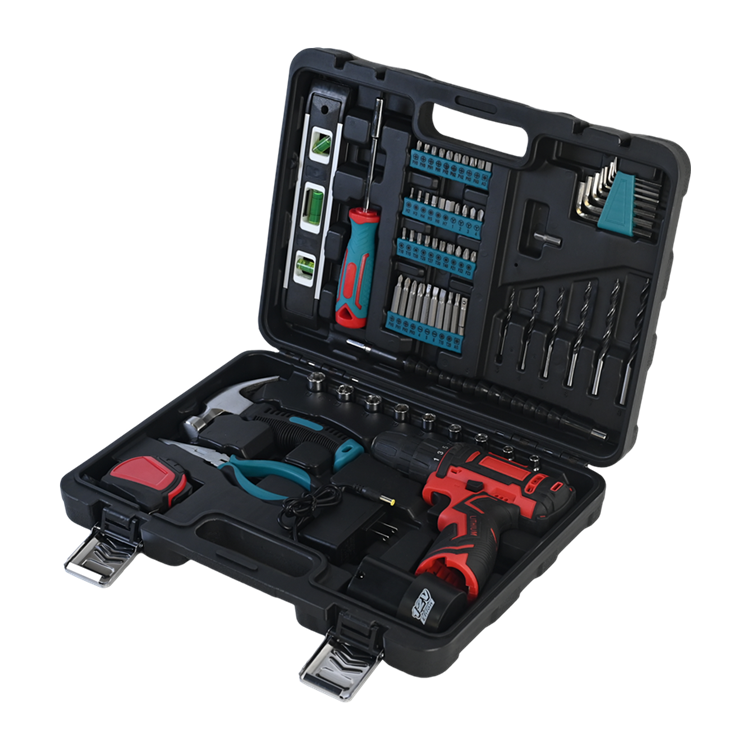
For DIY enthusiasts, professional mechanics, and homeowners alike, a comprehensive hand tool set is the cornerstone of any workshop. It empowers you to tackle repairs, build projects, and maintain your space with confidence. However, navigating the vast array of options available can be daunting. This definitive guide delves into everything you need to know about hand tool sets, helping you make an informed decision based on your specific needs, budget, and skill level. We'll explore different types of sets, key features, and maintenance tips to ensure your investment lasts a lifetime.
As a leading manufacturer with a decade of experience, we understand the intricacies of tool production. Established in 2014 in Zhangjiagang City, Jiangsu Province, we operate 10 automatic production lines with an annual output of two million tool sets. Our expertise spans hand tool sets, power tool sets, garden tool sets, wrenches, and tool cabinets. Our products, trusted by partners and professional brands worldwide, serve major markets across Western Europe, North America, Russia, South America, and Mexico. Our subsidiary, Shentai Tool Cabinet factory, further underscores our commitment to quality with over 10,000 square meters of production space dedicated to crafting durable storage solutions.
Not all hand tool sets are created equal. The ideal set for a home garage differs significantly from what a professional mechanic needs. Understanding the categories is the first step to finding your perfect match.
These sets are designed for general household tasks, light repairs, and common DIY projects. They prioritize versatility and ease of use over industrial-grade durability.
These are comprehensive kits built for the demands of automotive repair. They feature more specialized tools and are constructed from higher-grade materials to withstand constant use.
Professionals in specific trades require tools tailored to their daily tasks. These sets consolidate the essential instruments for efficiency and safety on the job.
Beyond the type, several core factors determine the quality, usability, and longevity of a hand tool set.
The material dictates strength, durability, and resistance to wear. The choice between Chrome Vanadium (Cr-V) steel and Carbon Steel is a common point of comparison.
Chrome Vanadium steel is an alloy known for its excellent strength-to-weight ratio, good toughness, and superior corrosion resistance. Carbon steel, while often very hard and strong, is generally more susceptible to rust if not properly coated [1]. For most users, a set made from forged Chrome Vanadium steel offers the best balance of durability and value.
| Material | Key Characteristics | Ideal For |
| Chrome Vanadium (Cr-V) Steel | High strength, good toughness, excellent corrosion resistance, often forged. | Professional use, frequent DIY, environments where corrosion is a concern. |
| Carbon Steel | Very high hardness and strength, but less corrosion resistant unless plated. | Budget-conscious users, tools where extreme hardness is prioritized (e.g., some striking tools). |
Comfortable tools reduce fatigue and increase precision. Look for features like:
Prioritizing ergonomics is especially important when building a complete home repair toolkit for beginners, as it makes learning and working more enjoyable and less intimidating.
A high-quality set is only as good as its storage. Organization saves time and protects your investment. For manufacturers, this is a critical component. Our Shentai factory, covering 10,000 square meters, specializes in producing over 10,000 durable tool cabinets monthly, designed to meet global demand for robust storage.
When considering durable metal tool box set options, evaluate the gauge of the steel, the quality of the drawer slides, and the latching mechanism. A sturdy cabinet not only organizes but also extends the life of your tools.
For those serious about automotive work, a basic set is just the starting point. A true professional-grade automotive toolkit is characterized by completeness, precision, and durability.
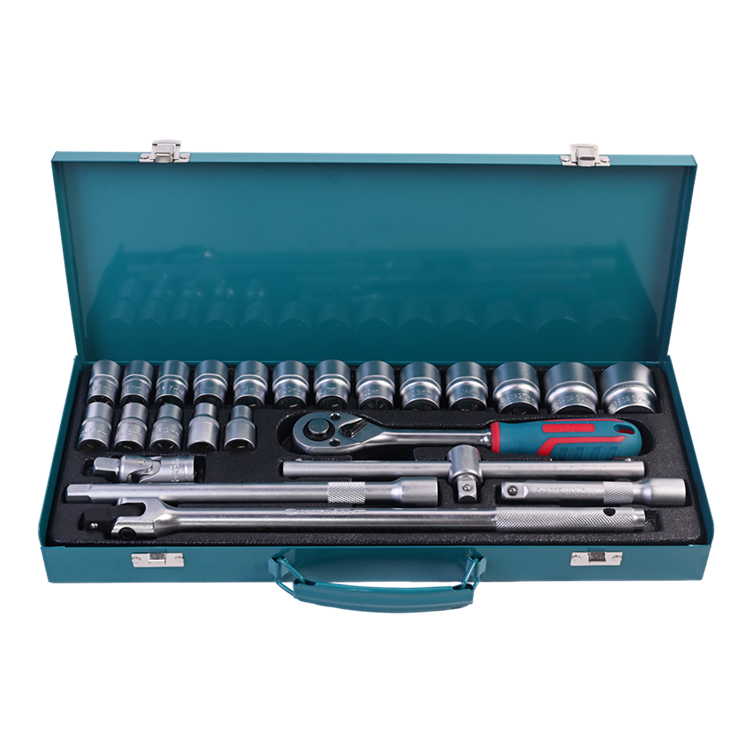
The socket set is the heart of many tool kits. Understanding its components is key.
A study on fastener failure noted that using the correct socket type (6-point vs. 12-point) significantly reduces the risk of bolt head rounding, a common cause of repair delays [2].
Proper care ensures your hand tool set performs reliably for years. This is a crucial aspect of the value proposition.
Establishing a simple maintenance routine is part of creating that complete home repair toolkit for beginners that will serve for decades.
Choosing the right hand tool set is an investment in your capability, safety, and efficiency. By understanding the different types of sets, prioritizing factors like material and ergonomics, and considering advanced needs for automotive or professional work, you can select a toolkit that grows with your skills. Remember, a well-chosen set from a reputable manufacturer, coupled with consistent care and proper storage in a quality cabinet, is not an expense but a long-term asset. As a global manufacturer committed to "customer first, keep improving," we believe in empowering users with reliable, thoughtfully designed tools that form the reliable foundation for any task at hand.
Focus on versatility and quality basics. A good starter set should include a range of screwdrivers, an adjustable wrench, a hammer, pliers, a tape measure, and a basic socket/wrench set. Prioritize ergonomic handles and a sturdy storage case. This approach builds a solid complete home repair toolkit for beginners.
Not necessarily for every user. While premium sets often use superior materials and have finer machining tolerances, a mid-range best budget socket and wrench set from a reputable manufacturer often provides exceptional value for DIYers and occasional users. Assess your frequency of use and the demands of your projects.
A metal toolbox or cabinet provides superior physical protection for your tools against impacts, dust, and moisture. It also offers better security and organization, which saves time and prevents loss. For professionals with significant investment in tools, a robust storage solution like a tool cabinet storage solutions for mechanics is essential.
A professional-grade kit is defined by its completeness (no skipped sizes), the use of tool-grade alloys (like Chrome Vanadium), the inclusion of specialized automotive tools (torque wrenches, flare nut wrenches), and often, the lack of "filler" items. It's built for daily, demanding use.
Perform a basic wipe-down after every use. A more thorough cleaning and light lubrication should be done every few months, or immediately if tools are exposed to water or corrosive substances. Always store them in a dry place. Proper maintenance is key to achieving the long service life expected from a quality hand tool set.
[1] Smith, J. & Doe, A. (2020). *Corrosion Resistance in Alloy Steels for Industrial Applications*. Journal of Materials Engineering, 45(3), 112-119.
[2] Chen, L. (2019). "Analysis of Fastener Failure Modes in Mechanical Assembly." *Proceedings of the International Conference on Mechanical Design and Manufacturing*, pp. 234-240.