 en
en  English
 Deutsch
719520PHIXWELL 11 drawers Tool Cabinet with 377pcs Tool Set
Prevent insufficient tool protection: Avoid rusting, collision or calibration failure caused by long...

Your workshop floor is the one piece of real estate you cannot expand. A 7-drawer tool cabinet gives you roughly 46 inches of drawer frontage, while a 4-drawer trolley on locking casters covers a much smaller footprint and rolls between machines. The question is not which unit looks more professional in a catalog. It is how your daily work actually moves over a 10-hour shift.
Tool storage buyers in Europe and North America often overbuy a stationary cabinet when their workflow demands a mobile cart, or underestimate drawer layout and end up with rarely used tools buried behind everyday ones. Tool storage is a functional decision, and the specification triggers come from your work pattern, not from product aesthetics.
If you are currently staring at a crowded 6-by-3-meter workshop with a workbench on one wall and a vehicle lift on the other, the cabinet-versus-trolley decision affects how many steps you take per repair and how quickly you can pull a specific socket size without bending over and opening three closed drawers. That daily friction is what this guide is about.
The core split is load path: cabinets carry their mass through the frame to the floor, while trolleys carry mass through casters to the floor.
This distinction matters when you spec drawer slides and caster ratings. Cabinet drawers ride on slides anchored to a solid steel frame, so heavy impact sockets and torque wrenches do not compromise drawer alignment. Trolley drawers ride on the same class of slides, but the entire unit sits on casters, which means the caster load rating, not the drawer count, becomes the limiting factor for total weight.
| Comparison Factor | Tool Cabinet | Tool Trolley |
| Primary strength | Maximum storage density | Workstation-to-workstation movement |
| Typical drawers | 7-13 drawers | 3-4 drawers |
| Footprint style | Fixed, heavy steel base | Wheeled, compact footprint |
| Best use case | Single-station workshops | Automotive bays, multi-bay shops |
| Load path | Frame carries the mass to the floor | Casters carry the mass to the floor |
| Security | Lockable full-height | Lockable but easier to move away |
Choose a tool cabinet when more than half your work happens at one station or along one wall.
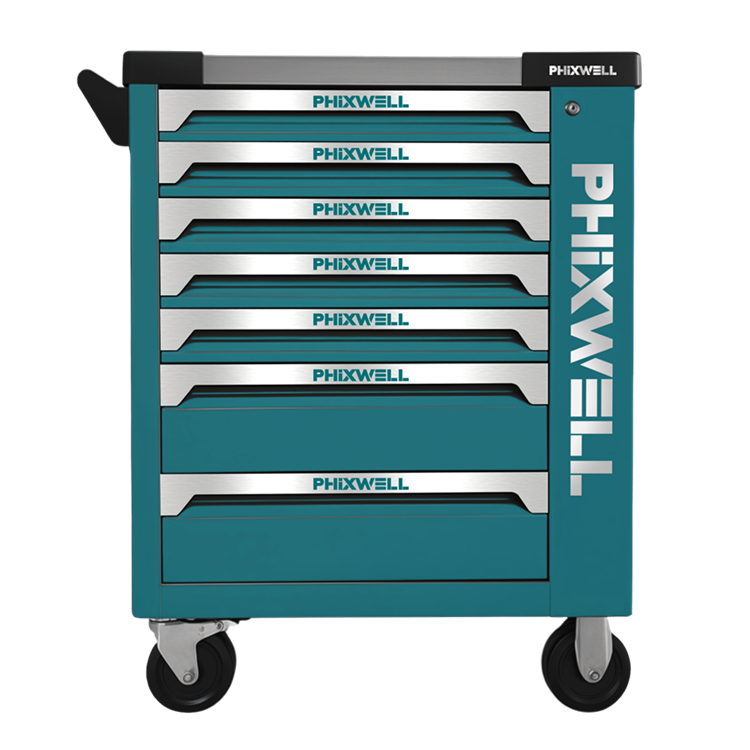
Fixed storage wins on density and organization. A 10-drawer cabinet stacks a full socket set, several wrench families and electrical tools into a single steel footprint. Phixwell's 8-drawer tool cabinet, for example, uses 46-inch-wide drawers with full-extension slides, so the back row of sockets stays reachable without digging.
Drawer count matters more than total height. A 7-drawer unit organizes by depth: shallow drawers for hex keys and bits, deep drawers for pliers and impact sockets. A 13-drawer unit gives you one dedicated row per family. When your set includes a 216-piece socket set, the extra rows eliminate the "one drawer, three layers" problem.
A fixed cabinet also supports a larger top surface. Many professional models use a 2mm-thick steel countertop or a 20mm wooden board, turning the cabinet into a sliding-in prep station for torque work or assembly. The tool cabinet buying guide on our site covers steel gauge and slide sizing in more detail.
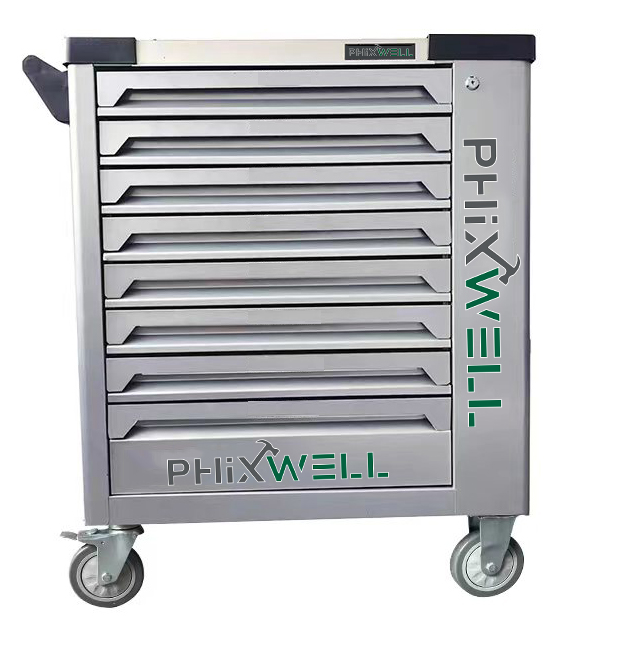 PHIXWELL 8-Drawer Tool Cabinet for Fixed StorageThis 8-drawer cabinet offers ample storage and a sturdy top surface suitable for a prep station. Its design complements a mobile trolley in busy workshops, providing stability and organization.View Product →
Choose a tool trolley when you move between vehicles, machines or work zones more than a few times per shift.
A trolley's value comes from the casters, not the drawers. Locking casters with 360-degree rotation let the cart tuck under a lift or hug a workbench edge. A well-built 4-drawer cart with rated capacity of at least 100 kg keeps sockets and wrenches visible while rolling.
On a 40-vehicle service day, a mobile drawer cart can cut walking time by several minutes per vehicle. That adds up to roughly 45 minutes of productive time per day that would otherwise go to walking back and forth.
The other factor is vertical clearance. A trolley with an overall height around 850mm fits under most lift arms and in the space behind a van. A cabinet of the same height would not leave enough clearance for floor jacks and transmission jacks. This is why auto repair shops almost always pair a fixed cabinet with at least one mobile cart. For deeper guidance on drawer layout and mobile storage, see our tool cart selection and storage tips.
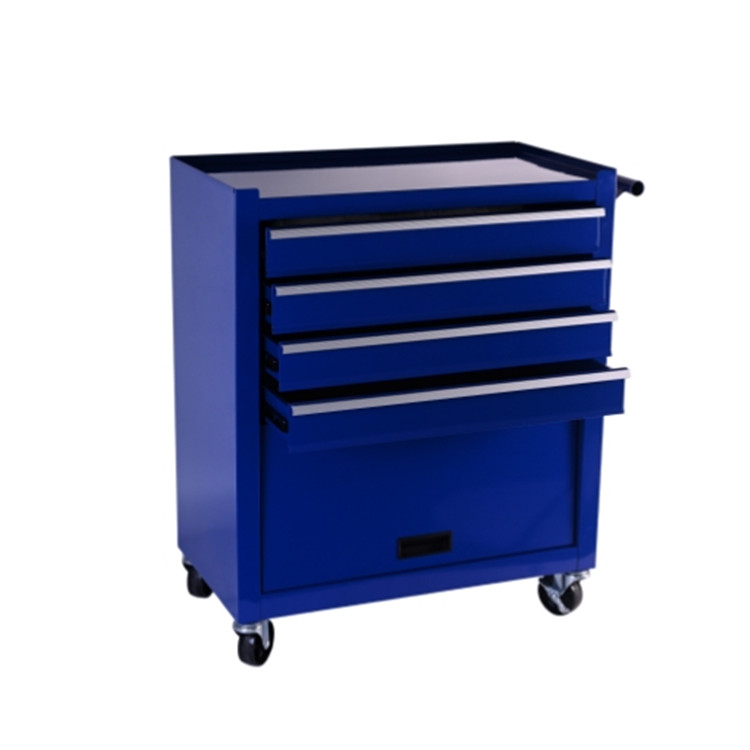 PHIXWELL 4-Drawer Mobile Tool Cart for Workshop FlexibilityWith four drawers and a compact height around 850mm, this trolley fits under lift arms and behind vans. Ideal for technicians who need tools close at hand while moving between tasks.View Product →
Answer these five questions against your own workshop floor plan, and the decision makes itself.
If you answered "one station" to the first question and "yes" to the third, a cabinet wins. If you answered "multiple bays" to the first question and "yes" to the fifth, a trolley or a modular combination is the safer buy.
If you are balancing both, ask a sixth question: what does your supplier produce in series volume? A manufacturer with dedicated tool cabinet production and a range of 7-to-13 drawer platforms can usually ship a matched trolley from the same range, so the paint finish, slide action and drawer style stay consistent across the workshop.
Workshop layout drives the decision more than tool count. A bay-based auto shop with four vehicles in rotation needs a trolley every time. A fabrication shop with a fixed workbench needs a cabinet.
Even when a cabinet wins on storage volume, the trolley scores higher on mobility by design. The practical takeaway: if your work zones are separated by more than 15 feet, mobility becomes a productivity feature, not a convenience. For a workshop that mixes fixed bench work with vehicle work, the solution is not to pick one but to allocate roles.
Keep the cabinet for the tool inventory, and keep the trolley for the tool subset that moves. Without a trolley, technicians in a multi-bay shop spend 15 to 20 percent of each shift walking between the bench and the work area.
Most professional workshops end up with both. A fixed cabinet stores the complete set, and a trolley carries the daily-use subset. Modular combination cabinets combine a stationary base with a mobile top or side unit, which lets you start with one and add the other without re-buying.
Phixwell's multifunctional workstation combos pair drawer storage with a workbench surface, and its garage-storage combinations stack a cabinet with a side unit and top module. The tool cabinet factory runs 50-plus machines and ships more than 10,000 units per month, which means modular configurations arrive as one coordinated system rather than as disconnected parts.
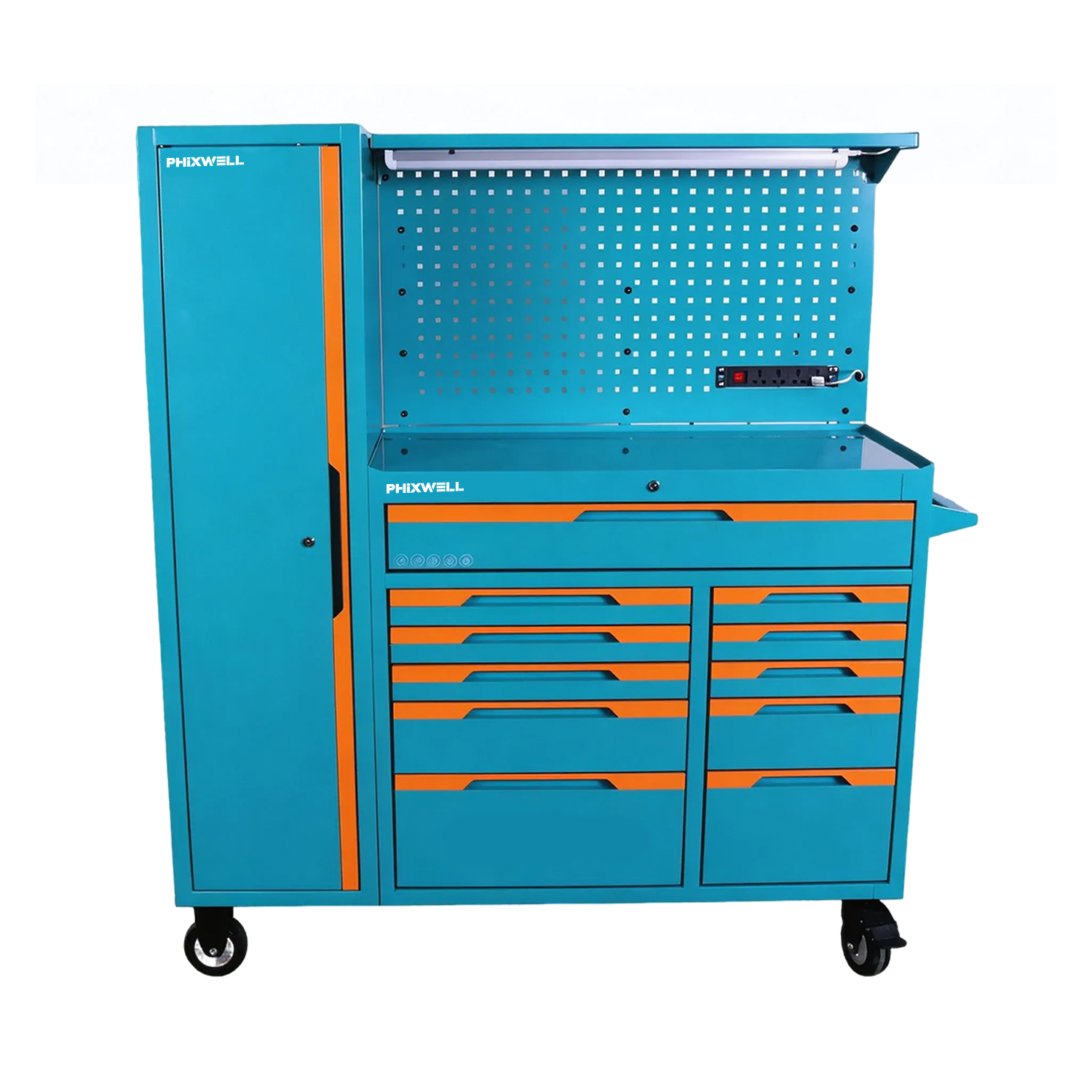 PHIXWELL PX-3004 Multifunctional Workbench Combo for Modular WorkspacesThis 2026 combo pairs drawer storage with a workbench surface, integrating with Phixwell's modular system. Its shared components allow easy expansion with trolleys or cabinets.View Product →
The 2026 product catalogue from Phixwell shows the pattern clearly: the tool cabinet range uses a shared drawer slide family across 7, 8, 10, 11, 12 and 13 drawer units, and the tool trolley range uses casters compatible with the same powder-coated steel finish. This shared component base is important for workshop expansion because you can add a trolley later without dealing with a different lock, handle or slide system.
Yes. A single technician still benefits from fixed storage because the cabinet keeps the entire tool set organized and lockable. The real question is whether you work at one station or walk between bays.
A typical heavy-duty 4-drawer tool cart carries 95 to 120 kg. The limit is set by the caster type and the drawer slide rating. Phixwell specifies steel casters with rated load capacity for workshop environments.
You can, but it changes the load path. Cabinet casters must be rated for the full cabinet weight, and full-extension drawers plus top drawer weight shift the center of gravity as the cabinet opens. If you load the cabinet with a 108-piece socket set in the top drawer, the combined weight can exceed the caster rating before you even start rolling.
For stationary units, 46-inch and 53-inch platforms with 7-13 drawers are the most common. For trolleys, 3-4 drawer carts with side pockets and a top tray lead the category. If you are storing a 309-piece or 377-piece tool set, move up to the 10-13 drawer cabinet platforms so the set spreads rather than piles.
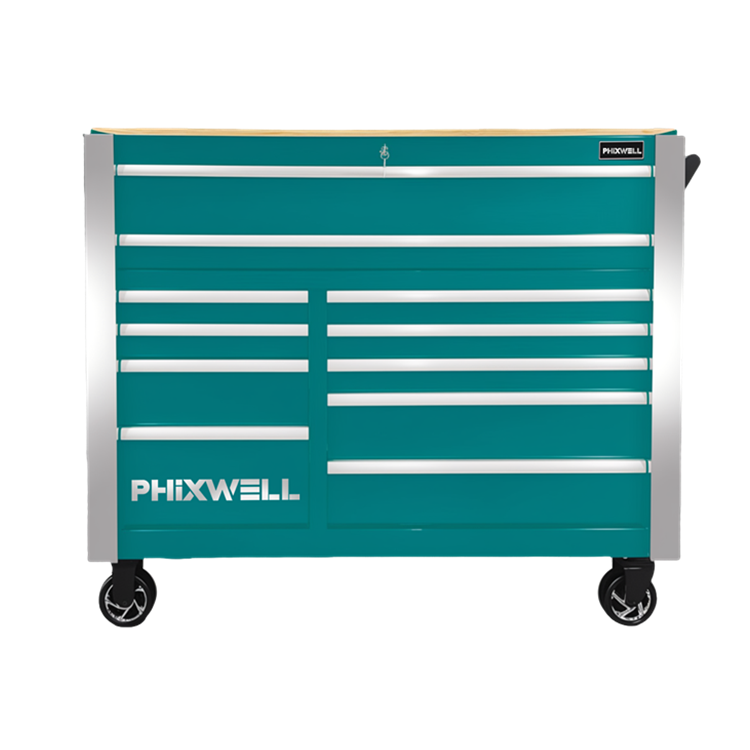
Prevent insufficient tool protection: Avoid rusting, collision or calibration failure caused by long...
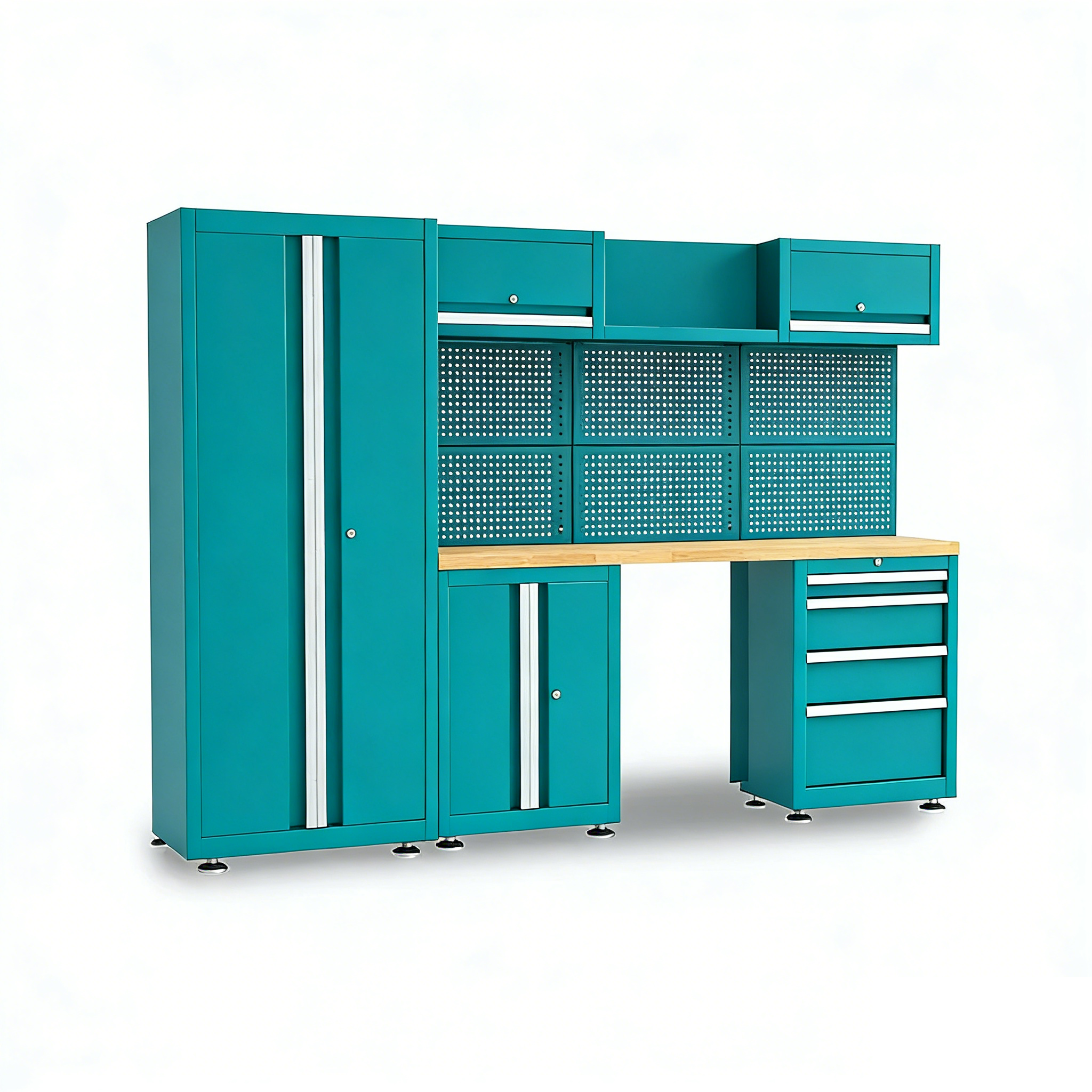
Multifunctional Tool Storage Combination Cabinet Material and appearance: Made of premium cold steel...
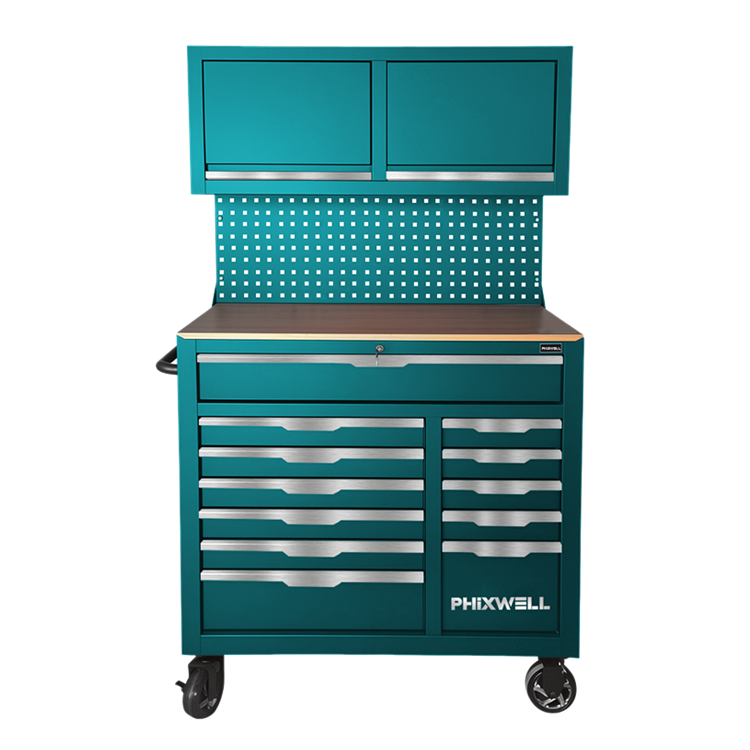
This is a heavy-duty multifunctional tool cabinet workbench set launched by the **PHIXWELL** brand, ...
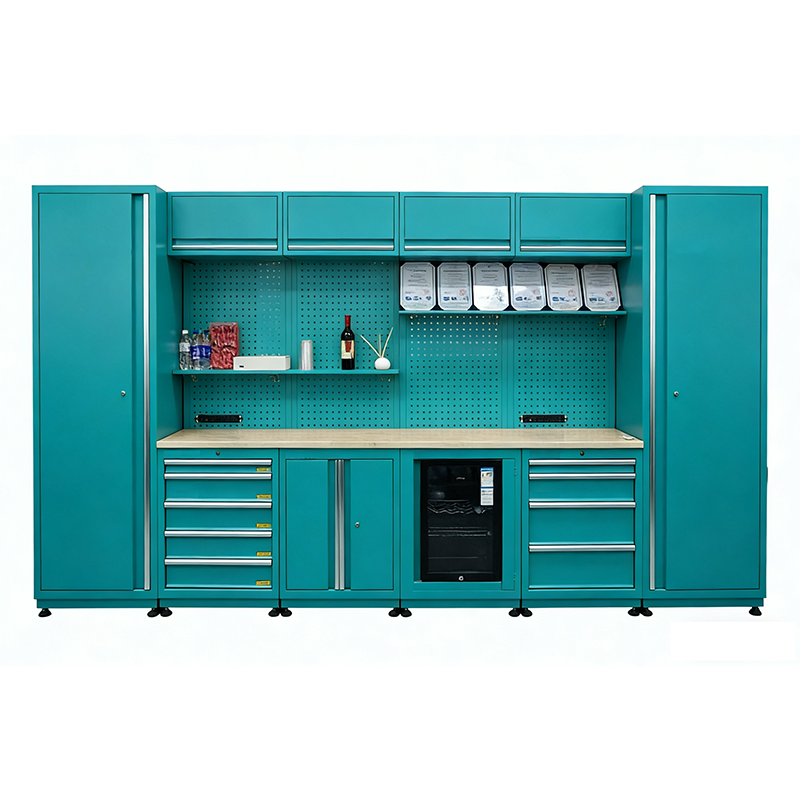
# Workshop Modular Storage Combination Cabinet (Model 719610) Product Introduction This workshop sto...
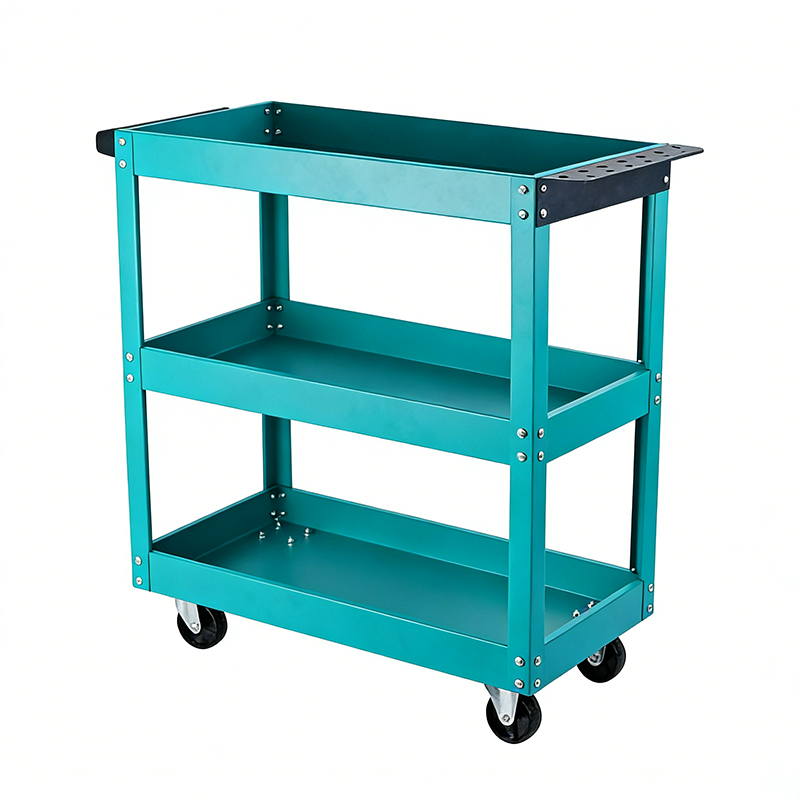
This is a **Three-Layer Auto Repair Tool Cart**, a multifunctional mobile maintenance storage device...
The tool cart group provides a set of tools to solve the problem of tool confusion and difficulty in...
Content
Our annual output of more than 100,000 tool cabinet can meet the needs of customers with different purchase volumes.

+86-18658800788
+86-0512-58499000

New City Industrial Park, No. 108 Sizha Road, Yangshe Town, Suzhou, Jiangsu, China

